
Tags and Other Frameworks

Other Frameworks
There are many great methods, books, and frameworks out there on how to identify and prioritize risky assumptions, hypotheses, and questions.
All the methods in this book are tagged so they are easily searchable depending on any other frameworks we might use. This includes simple tags such as qualitative or quantitative, which are used to denote the type of information the method produces.
It also includes tags related to the type of business model, such as:
- B2B for business-to-business
- B2C for business-to-consumer
- B2G for business-to-government
- Two-Sided Market for a business with buyers and sellers.
These are included for convenience and additional context. Only using those tags to navigate may result in a large selection of methods not entirely suited to the learning goal.
Using the Business Model Canvas
The Business Model Canvas is a popular framework that identifies the nine basic building blocks of any business model and asks us to make assumptions as to what our business will be. Those blocks are:
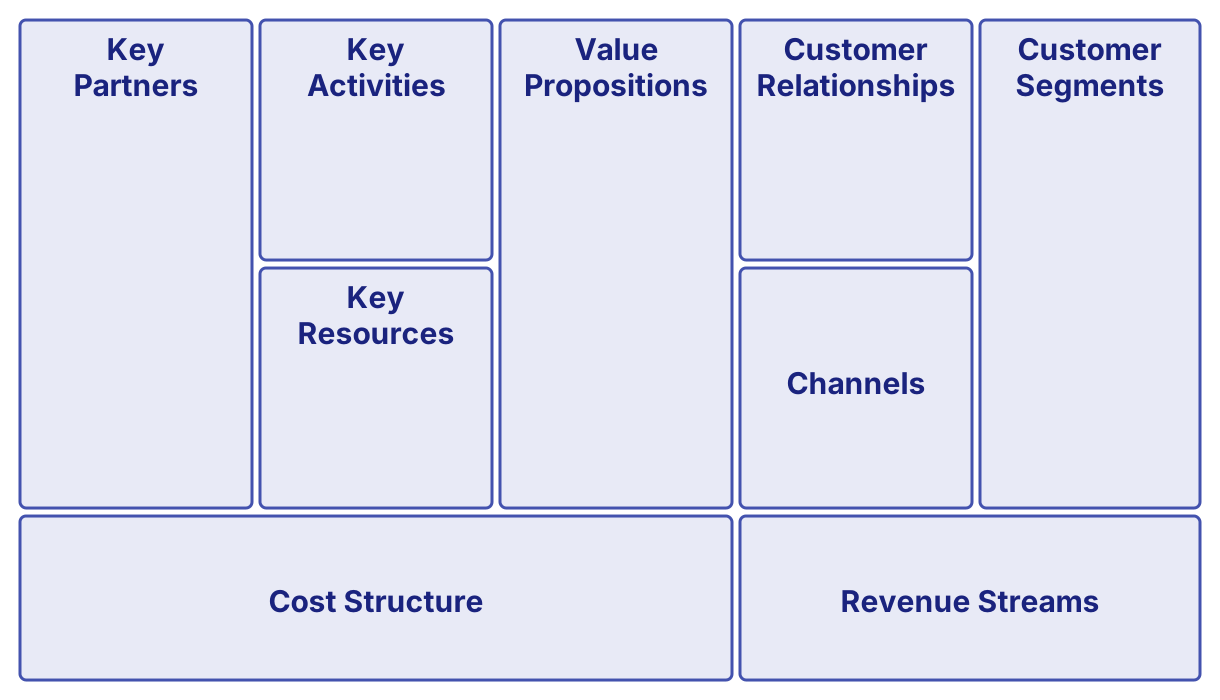
Based on our completed canvas, we choose the area of greatest risk to our success. Sometimes this is the customer segment, but in the case of an existing market it may be the value proposition, channels, or even key partners.
Each method in this book is tagged with these blocks. If we can identify the greatest risk to our business model via the Business Model Canvas, we can search the tags for a complete list of experimental methods relating to that building block.
For example, if the customer is the biggest risk to our customer segment, then we are asking “Who is our customer?” or “Is this our correct customer segment?” Based on that, there are several tools available to learn more about our customer, including:
- Discovery interviews
- Contextual Inquiry
- Data mining
- Surveys (closed-ended)
- Focus groups
This search won’t differentiate between generative research and evaluative experiments, so you’ll still need to take that extra step.
Tags
These tags are auto-compiled from all method and parent pages.
Business model tags
Research type
- Qualitative (44)
- Quantitative (39)
All tags
- Attitudinal (24)
- B2B (3)
- B2C (4)
- B2G (1)
- Behavioral (25)
- C2C (1)
- DTC (3)
- In-person (40)
- Observational (21)
- Qualitative (44)
- Quantitative (39)
- Remote (62)
- Transactional (10)
- Two-Sided Market (1)