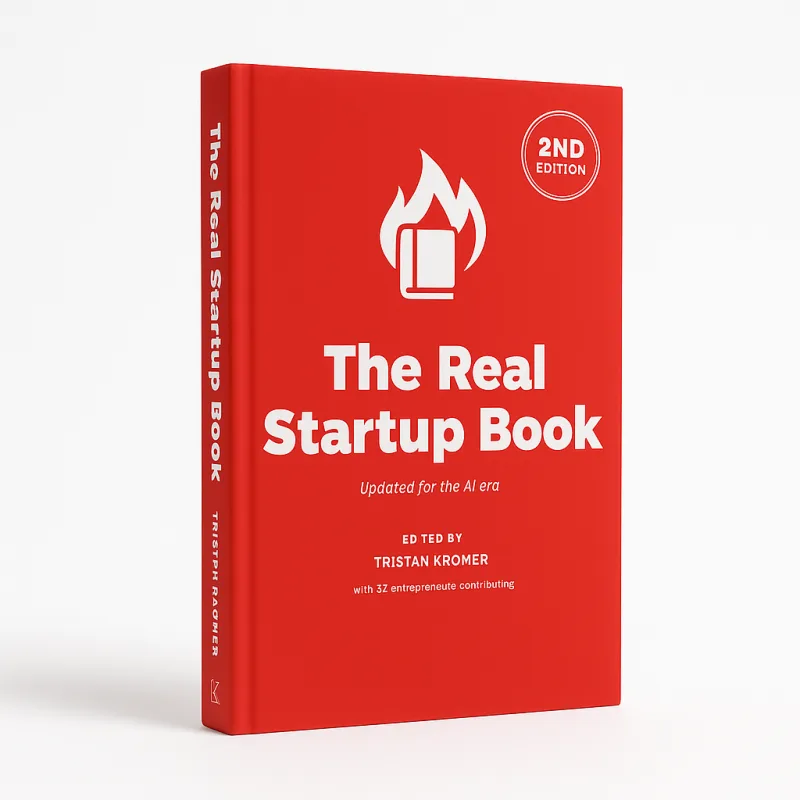
Foreword to the Second Edition

We are living through a fascinating moment in the history of innovation.
Artificial Intelligence is changing how products are imagined, designed, and built. Tasks that once took innovation teams months can now take days. In some cases, even hours. A small team with the right AI tools can create prototypes that look and feel like finished products almost instantly.
And yet, for all this technological change, one thing remains remarkably constant:
The job of any startup or innovation team is to discover what creates value for customers and build a business that can deliver that value in a profitable way.
That is why The Real Startup Book remains so relevant.
Building ≠ Learning
I have spent the last decade working with startups, innovation teams, and corporate leaders around the world. One of the most common mistakes I continue to see is that teams confuse building with learning. The most difficult discipline has always been to learn first and then build.
I once worked with a team at a publishing company that spent over six months and thousands of dollars building their platform, only to learn within the first week of launch that they had built the wrong thing.
This shows that the ability to create something is not the same as understanding whether it should exist in the first place.
In many ways, AI reducing the costs of building makes the discipline of learning even more important. When product creation becomes easier, the world fills up with more ideas, more prototypes, more experiments, and more noise.
But speed is not the same as insight. The real challenge is learning what matters.
That is where Tristan Kromer and his fellow contributors’ work stands apart.
Discipline in the Age of AI
What makes The Real Startup Book so powerful is that it treats innovation not as a collection of rituals, but as a disciplined search for evidence. At the heart of the book is a deceptively simple framework that illustrates how:
- Teams need to learn about customer’s problems and test their solutions
- This learning can be based on specific hypotheses or be generative in nature
This framework forms the basis of how teams can choose the right experiments to discover unmet customer needs, test solutions, and validate demand.
Over the years, I have worked with teams that jump too quickly into evaluating solutions before they understand the problem space. Other teams spend months talking to customers without ever testing whether people will actually change their behavior or pay for a solution. The way that Tristan Kromer has laid out the book helps teams understand not only how to experiment, but what kind of test is needed at each stage of their innovation journey.
Timeless and Contemporary
What is most impressive about this book is that it combines timeless principles with contemporary relevance. There is a timeless focus on key innovation principles; understanding customer problems, testing assumptions, validating demand, and systematically searching for scalable business models. These fundamentals will not change any time soon.
But the contemporary relevance of this second edition is equally impressive.
Tristan embraces the reality that the tools of experimentation are evolving rapidly. So this edition includes newer AI-enabled approaches to experimentation, such as Disposable MVPs, along with AI-assisted prompts and methods that help teams design experiments and interpret results more effectively.
In a world increasingly obsessed with speed, The Real Startup Book is a reminder that thoughtful learning is still one of the greatest competitive advantages a startup or innovation team can have.
I hope you find this new edition as useful, practical, and thought-provoking as I have.
And most importantly, I hope it helps you build something people truly want.
— Dr. Tendayi Viki