From Question to Method

Once we have the right questions, we need to find the right method. To do this, we need to understand the difference between Market vs. Product questions and Generative vs. Evaluative questions.

  1. Do we need to learn about the problem (ie, market) or the solution (ie, product)?
  2. Do we have a falsifiable hypothesis to evaluate, or do we need to generate a clear idea?

Market questions are those relating to levels of customer demand, user problems, segmentation, or market size. Product questions relate to what solution would solve the market need.

Generative questions are open-ended where there is not necessarily one clear answer. Evaluative questions are specific, closed-ended questions where there is one specific true answer or a yes/no answer.

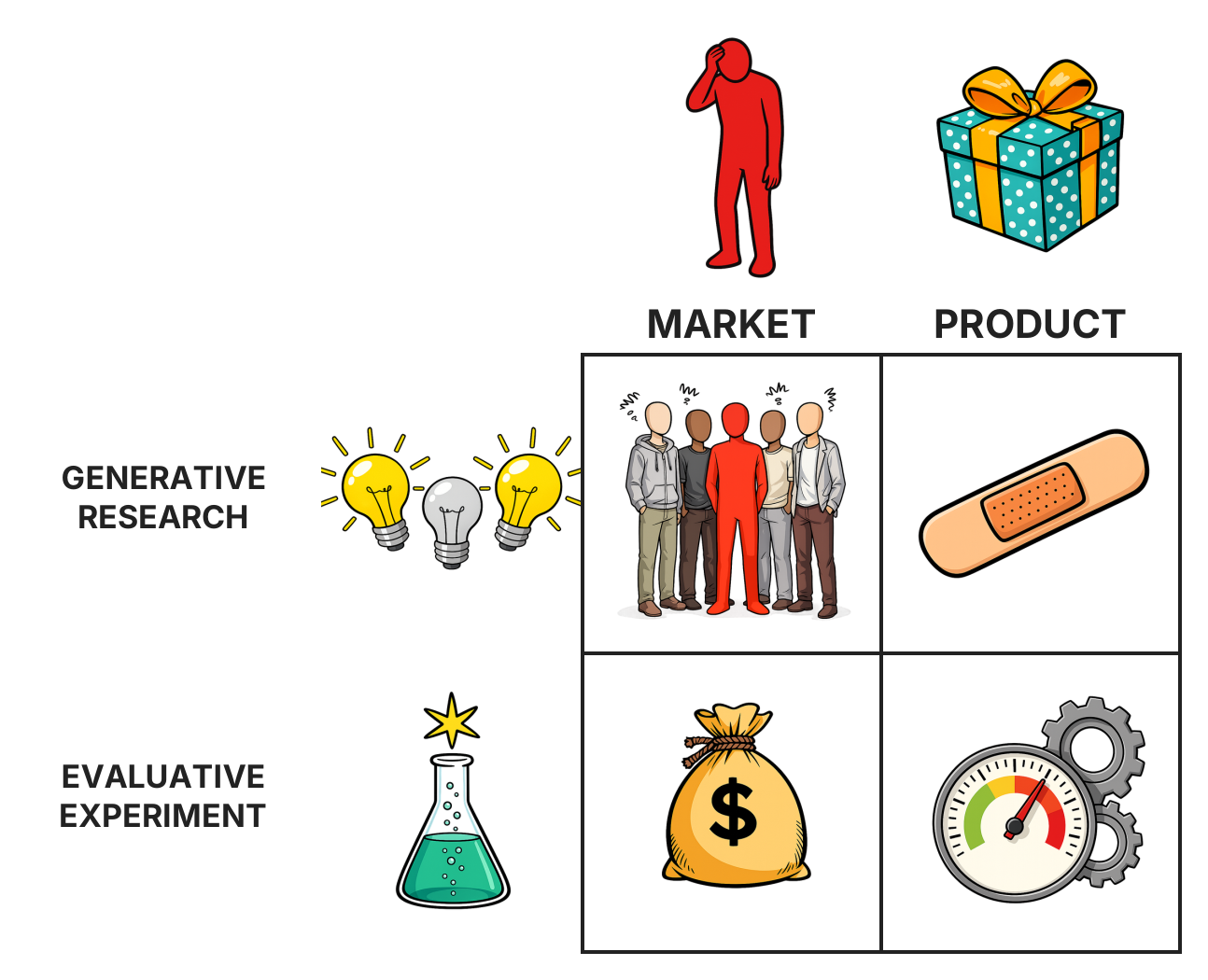
Mapping the intersection of these two distinctions gives us a 2x2 matrix with four possible quadrants:

A 2x2 framework matrix mapping market vs. product on the columns and generative research vs. evaluative experiment on the rows, with iconographic cell content for each quadrant

A printable version of this 2×2 is available on kromatic.com for whiteboards and team workshops.

Each of these quadrants directly relates to a set of questions to answer and methods that will generate the exact right data to answer those questions.

If we have a clear hypothesis of who our customer is and what we think they will pay for, then we can run an experiment from Evaluative Market Experiments, such as a Value Proposition Test.

If we don’t have a clear idea of who our customer is and it’s open-ended, we can do Generative Market Research, such as Data Mining.

Similarly, if we have a clear hypothesis of which features will solve the customer’s problems, we can run an experiment from Evaluative Product Experiments, such as Wizard of Oz testing. If we do not know which features will lead to an acceptable solution, we can do Generative Product Research such as a Concierge Test to try to come up with new ideas.

This framework is deliberately simple. A single customer interview question (generative research) can generate a new hypothesis, and the next question can invalidate it. An MVP built to check a product feature (evaluative experiment) can surface new market hypotheses by accident.

The Index of Questions and the Index of Methods show a list of example questions and their corresponding methods. But the next few chapters will go into more detail on how to distinguish the different types and help us navigate the four quadrants.
AI Prompt — Locate Your Question on the 2×2

You are a research-methods expert helping me find the right method in this book for a question I want to answer. Classify my question on two axes — Market vs. Product and Generative vs. Evaluative — and then point me to the chapter that contains relevant methods.

My one priority question is: [PASTE ONE QUESTION, NOT A LIST].

The context behind this question is: [TWO TO FIVE SENTENCES ABOUT THE BUSINESS, THE STAGE, AND WHY THIS QUESTION MATTERS].

Work through the following steps in order, and do not skip the rationale:

  1. Classify the question on the Market vs. Product axis. A market (or problem) question is about the customer, the problem, segmentation, channels, willingness to pay, or any element on the right side of the Business Model Canvas. A product (or solution) question is about the solution, features, design, key activities, or any element to the left of the value proposition. If the question sits on the boundary, name both sides and tell me which is the larger share.
  2. Classify the question on the Generative vs. Evaluative axis. A generative question is open-ended ("Who is our customer?"). An evaluative question is closed-ended and tied to a falsifiable hypothesis ("Will this customer segment pay $9.99 for this feature?"). If my question sounds closed-ended but lacks a clear hypothesis, treat it as generative — I need more discovery first.
  3. Place the question in one of the four quadrants (Generative Market, Generative Product, Evaluative Market, Evaluative Product). State the quadrant explicitly and explain in one sentence why.
  4. Recommend the chapter to start in. Generative Market → Generative Market Research. Generative Product → Generative Product Research. Evaluative Market → Evaluative Market Experiments. Evaluative Product → Evaluative Product Experiments. If the question is on the boundary, recommend the chapter that addresses the harder-to-reverse risk first.

If the question cannot be classified, say so and tell me what's missing — usually an unclear hypothesis, an unclear customer segment, or a question that conflates two distinct questions. Do not force a classification on an ambiguous question.

Reference material: The Kromatic MCP server (https://kromatic.com/mcp) indexes Real Startup Book, Kroblog, and Kromatic templates — use it to ground recommendations in book methodology.