
Product Prototyping - 3D Print
In Brief
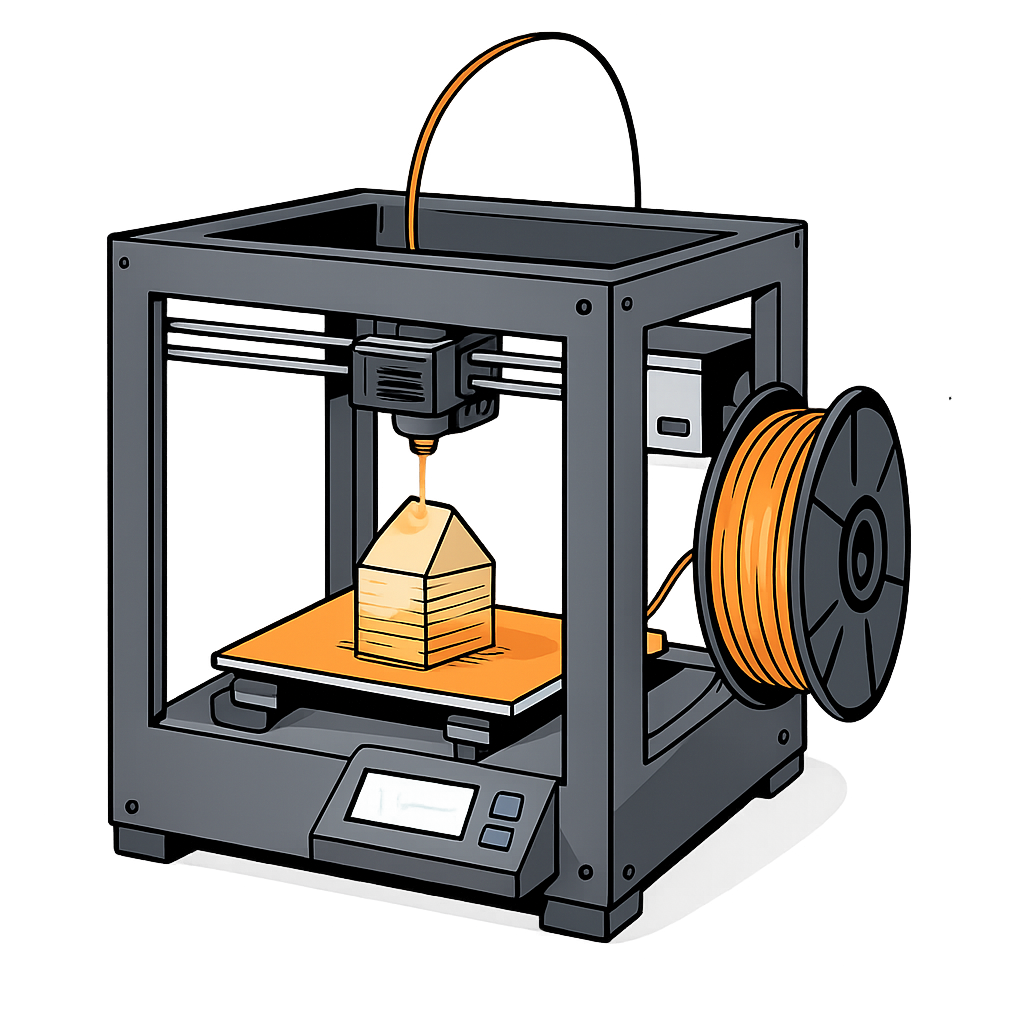
A 3D printed prototype is a physical model of a product concept that customers can hold, examine, and interact with physically. The purpose is to evaluate form factor, ergonomics, size, weight, and spatial relationships before committing to tooling or manufacturing. A 3D print is typically not a functional prototype — no electronics, no moving parts, no working mechanisms. The value is in making the physical design tangible so customers react to something real rather than imagining a product from a screen or drawing.
This is one of the fastest and cheapest ways to put a physical object in a customer’s hands: materials cost $5 to $50 and printing takes 1 to 24 hours depending on size and complexity. It sits between paper prototypes and life-sized prototypes on the fidelity ladder — physical enough to test ergonomics and form factor, cheap enough to iterate three or four variations in an afternoon.
Common Use Case
You have a physical product concept where dimensions, shape, or ergonomics are the open question, and you want a customer to react to a real object rather than a drawing or rendering. You have already validated the underlying problem and the rough product idea through interviews or paper prototypes, and you can spend $5 to $50 on filament and a day at a makerspace, library, or service like Shapeways to print and test two or three variations.
Helps Answer
- Does the physical form factor feel right in a customer’s hands?
- Is the product the right size and weight?
- Are buttons, grips, or interaction points in ergonomic locations?
- Does the product look like what customers expect?
- Are there physical design issues that are not apparent on screen?
Description
3D printing occupies a useful niche on the prototyping spectrum: physical enough to test things a screen cannot — ergonomics, form factor, spatial relationships — but cheap enough to iterate quickly. A product team might print three or four variations of a handle design in an afternoon and test all of them with customers the next day, something that would take weeks with traditional manufacturing.
The key limitation is that 3D prints are typically non-functional. They have no working electronics, no moving mechanical parts, and not the materials or finish of a final product. That is actually an advantage for early-stage testing: customers respond to the physical form without being distracted by whether the technology inside works. You are isolating the variable of physical design.
When to Use
3D printing is most valuable for products where physical form matters: consumer electronics, medical devices, kitchen tools, wearables, packaging, toys, furniture. It is less useful for purely digital products or services, though even software companies sometimes 3D print physical accessories, packaging, or hardware companions.
Use a 3D print when:
- You have a product concept where physical dimensions, shape, or ergonomics are critical.
- You need to test multiple form factor variations quickly.
- You want customers to react to a physical object rather than a drawing or rendering.
- You are deciding between physical design alternatives before investing in tooling.
How to
Prep
- Define exactly what you are testing. Be specific: overall size? Grip ergonomics? Button placement? Visual appeal? The answer determines how much detail your print needs and how to evaluate the result.
- Set pass/fail criteria before you print. Ergonomic thresholds, dimensional tolerances, “fits in the target use environment” checks. Without predefined criteria, the temptation is to rationalize a borderline print as good enough once you have spent the time and filament.
- Build the 3D model. Use Tinkercad (free, beginner-friendly), Fusion 360 (free for startups, more capable), or similar tools. Model only what matters for the test — if you are testing grip, the handle needs to be accurate but internal details do not. AI text-to-CAD tools can produce a first-draft mesh from a description; refine before printing.
- Choose the print process. FDM (filament) printers are sufficient for most prototyping and the most accessible. Use SLA resin printers if you need smoother surfaces or finer detail. If you do not own either, route to a makerspace, a library, or a service like Shapeways or Sculpteo.
- Print two or three variations. A single print is a single point of data. Print at least two variants — different sizes, different grip angles, different button placements — so customers can compare and reveal preference rather than just react.
- Post-process if needed. Sand rough edges, paint if color or finish matters to the test, add weight if the final product will be heavier than the plastic print. Surface finish should match the variable you are testing — if grip is the question, sand it; if visual presence is the question, paint it.
- Recruit participants. Recruit 5 to 8 customers from the target segment, with diversity in hand size, grip strength, and physical ability. Ergonomics vary across body types — an all-developer test pool will not represent the real customer.
Execution
- Present in context. Place the prototype in the environment where the final product will be used. Kitchen tool? Test it in a kitchen. Wearable? Have them wear it. Hand tool? Test it where the hand task happens. The realistic-context test only works if the context is actually realistic.
- Hand it over without a script. Give the participant the printed object and stay quiet. Watch how they pick it up, how they grip it, whether they rotate it, whether they look confused about orientation. Their unprompted physical interaction is the data; your narration about what the object does will bias the reaction.
- Use a think-aloud protocol after the first physical interaction. Ask the participant to narrate what they noticed while they were holding it. “How does that feel in your hand? Is it the right size? Where would you expect the button to be?” Record verbatim — language about size and weight (“bigger than I expected,” “lighter than it looks”) is signal.
- Test all variants with each participant. Hand them variant A, then B, then C. Ask which felt better and why. Counterbalance the order across participants — half see A first, half see B first — so order does not bias preference.
- Note the comparison products. Customers will naturally compare the prototype to products they already own. “Reminds me of a [X]” or “smaller than my [Y]” tells you the competitive physical-design landscape and the mental category the customer puts the product in.
- Capture the failure modes. When a participant adjusts their grip after picking it up, when they cannot tell which side faces forward, when they ask “is this real?” — those are the failures. Write them down precisely; the reason for each failure is the redesign target.
Analysis
- Score each variant against the pass/fail criteria separately. Do not aggregate into “best variant.” A variant can pass on grip and fail on visual presence, and the two failures route to different fixes.
- Cluster the unprompted physical interactions. When most participants adjust their grip after picking it up, the form factor is the problem. When most participants rotate the object to find the orientation, the affordances are the problem. The unprompted behavior is more reliable than the verbal report — the verbal report often rationalizes the physical reaction.
- Map the verbal feedback to specific physical features. Group quotes by feature (handle, button, weight, surface). Quotes that cluster on one feature mean that feature is the problem; quotes spread across many features mean the overall concept is the problem.
- Reconcile with the comparison products participants named. If customers consistently compared the prototype to a product in a different category than you intended, the physical design has placed it in the wrong mental category. That is a positioning problem the prototype surfaces, not a manufacturing problem.
- Decide the next move. One of three things should happen: a variant clearly passes on the criteria → lock the form factor and move to a Single Feature MVP or Life-Sized Prototype that adds function; one variant is close but fails on specific criteria → iterate on those features and reprint only the affected geometry; all variants fail across criteria → return to the underlying concept and reassess whether the physical form is the right approach to the customer’s problem.
- Material mismatch 3D printed plastic feels different from the production materials (metal, rubber, glass). Customers may react negatively to plastic when the final product will use a different material. Acknowledge this upfront and ask them to evaluate shape and ergonomics, not material feel.
- Novelty effect Customers may be excited by the novelty of holding a 3D printed prototype regardless of whether the design is good. Discount initial enthusiasm; focus on specific behavioral observations and on the comparison between variants.
- Visual fidelity distraction Visible layer lines or rough surfaces draw comments about surface quality rather than form. Sand and paint the prototype if surface finish is distracting from the variables you are testing.
- Single-user bias Ergonomics vary across hand sizes, grip strengths, and physical abilities. Test with a diverse range of users, not just your immediate network. An all-developer test pool will not represent the real customer.
- Order effects in variant comparison Whichever variant the participant holds first sets the reference frame. Counterbalance order across participants — half see A first, half see B first — so order does not bias preference.
- Sunk-print fallacy Hours of design and printing time create pressure to declare the print “good enough.” Honor the pass/fail criteria you set in Prep; a failed print is data, not waste.
Learn more
Case Studies
Formlabs and dental aligners
Formlabs documents how dental labs and orthodontic startups use desktop SLA printers to iterate on aligner geometry and produce patient-specific test prints in hours rather than weeks. The 3D printing step lets the design team test fit and patient comfort with real-mouth scans before any tooling investment for thermoforming molds.
Adidas Futurecraft 4D
Adidas partnered with Carbon to 3D-print midsole lattices for the Futurecraft 4D running shoe. The team iterated on lattice geometry across hundreds of printed variants — testing cushioning, energy return, and runner feedback on physical samples — before locking the production lattice for the launch shoe. The 3D-printed-midsole loop is now a documented part of Adidas’s product-development process.
GE Aviation fuel nozzle
GE Aviation redesigned the LEAP engine fuel nozzle as a single 3D-printed part instead of a 20-component assembly. Iterative 3D-printed prototypes let the team test geometry and fit at full scale during the design phase, surfacing thermal and flow issues that the CAD simulation missed. The prototype-to-production loop reduced part count from 20 to 1.
Lego Idea Lab
Lego’s product-design teams use desktop 3D printers in their internal Idea Lab to produce physical prototypes of new brick designs and play-feature mechanisms before any injection-mold tooling investment. The 3D-printed-brick test rounds catch ergonomic and play-pattern issues that the CAD review and small-batch resin samples did not.
Further reading
- Hod Lipson and Melba Kurman — Fabricated: The New World of 3D Printing (Wiley, 2013)
- Karl T. Ulrich and Steven D. Eppinger — Product Design and Development (McGraw-Hill, 2015)
- Bill Buxton — Sketching User Experiences (Morgan Kaufmann, 2007)
- Stephanie Houde and Charles Hill — What Do Prototypes Prototype? (Handbook of Human-Computer Interaction, 1997)
- Jake Knapp, John Zeratsky, and Braden Kowitz — Sprint (Simon & Schuster, 2016)
- Carbon — Digital Light Synthesis case studies
Got something to add? Share with the community.