
Value Proposition Test - Crowdfunding
In Brief
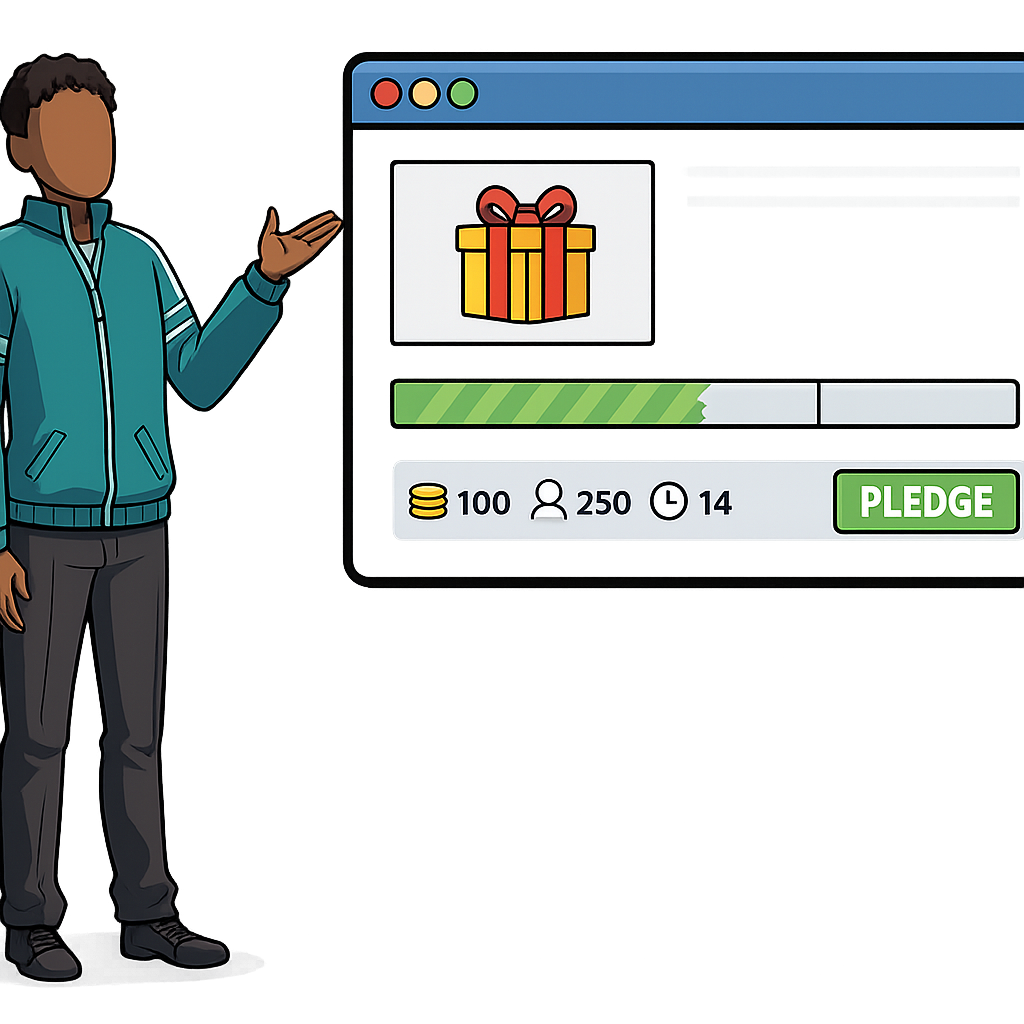
A crowdfunding smoke test is a campaign on platforms like Kickstarter or Indiegogo that tests whether customers will pay real money for a product that does not yet exist. The customer knows the product hasn’t been built yet — they are paying for a promise. This distinguishes crowdfunding from a Mock Sale (where the customer doesn’t know it’s a test) and from a finished product launch. Because backers make a financial commitment with full knowledge that delivery is uncertain, a successful crowdfunding campaign provides strong evidence of genuine demand.
This is NOT a product test. You are testing whether the value proposition is compelling enough that people will pay for something that doesn’t exist yet. The product itself is validated later, after delivery.
Common Use Case
You have a value proposition that has cleared lighter tests (interviews, landing page signups, ad CTR) and a product concept that benefits from public, pre-payment commitment — the kind of evidence that lets you order tooling, place inventory commits, or take the campaign to investors. You want to see whether enough people will pay before the thing exists, and you can absorb the multi-week preparation effort that a public campaign demands. Crowdfunding gives you that evidence at scale and with real money attached.
Helps Answer
- Will customers pay real money for this product before it exists?
- Is the value proposition strong enough to drive financial commitment?
- Which reward tiers or price points attract the most backers?
- Is there a community willing to champion this product?
Description
Crowdfunding smoke tests are part of the Value Proposition Test family — methods that test demand for a promise by asking participants to commit money, time, data, or actions. Pledges combine financial commitment with public, reputational stakes — among the strongest signals in the family.
Crowdfunding as a smoke test works because it asks customers to put real money behind a promise. Unlike surveys or landing page signups, financial commitment is hard to fake. A successful campaign tells you that a meaningful number of people want what you described enough to pay for it before it exists.
There are five primary crowdfunding models, each testing different aspects of demand:
- Rewards-based (Kickstarter, Indiegogo): Backers pay for a future product at different reward tiers. The most common model for product validation. Tests willingness to pay at specific price points.
- Equity crowdfunding (Wefunder, Republic): Investors buy shares in your company. Tests whether sophisticated investors believe in the business model, not just the product.
- Donation-based (GoFundMe): Supporters contribute without expecting a product in return. Tests mission resonance, not product-market fit. Relevant for social enterprises and nonprofits.
- Debt-based (Kiva, Funding Circle): Lenders provide capital expecting repayment. Less relevant as a smoke test.
- Recurring/patronage (Patreon, Buy Me a Coffee): Supporters pay ongoing amounts for continued access or content. Tests whether people will pay repeatedly for your value proposition.
For most product startups, rewards-based crowdfunding is the right model. It directly tests whether customers will pay for what you plan to build.
How to
Prep
1. Validate before you crowdfund.
Crowdfunding is not a first test. Run lighter experiments first — customer interviews, landing page tests, or online ad tests — to confirm basic interest before investing weeks in a campaign.
2. Build a pre-launch email list.
Pre-launch list size is widely cited as the single biggest predictor of campaign outcome. Start collecting emails 4-6 weeks before launch through a simple landing page, social media, and direct outreach to communities where your target customers gather.
3. Create your campaign page and video.
The campaign page needs: a clear explanation of what the product does and who it’s for, a compelling video (60-90 seconds), realistic product renderings or prototype photos, well-structured reward tiers, and a transparent timeline. Kickstarter requires honest representation — label renderings as concepts, not finished products.
4. Set a realistic funding goal.
Your goal should be the minimum amount needed to deliver on your promises. Setting a goal too high risks failure; setting it too low undermines credibility. Research comparable campaigns to calibrate.
5. Structure reward tiers strategically.
Offer 3-5 tiers that test different price points and bundles. Include an “early bird” tier at a modest discount to drive urgency in the first 48 hours. The distribution of backers across tiers tells you about price sensitivity.
Execution
1. Launch and promote aggressively in the first 48 hours.
Campaigns that hit a meaningful share of their goal in the first two days tend to outperform those that don’t, partly because the platforms’ discovery surfaces reward early momentum. Activate your pre-launch list immediately. Reach out to press, bloggers, and community influencers.
2. Track per-day pledge velocity, not just total raised.
The mid-campaign slump is normal — most campaigns do most of their pledging in the first 72 hours and the last 72 hours. What you want to watch is the slope of pledges per day relative to comparable campaigns. A flat middle is fine; a continually declining slope toward zero is a warning.
3. Communicate with backers throughout.
Regular updates build trust and generate word-of-mouth. Respond to questions quickly. Transparency about challenges increases backer confidence, not decreases it.
4. Hold the campaign page honest.
Resist the urge to add late-campaign claims or stretch goals that you can’t actually deliver. Backers screenshot promises, and the Kickstarter / Indiegogo terms of service treat a campaign page as a binding representation. Adding scope under deadline pressure is one of the most common ways successful campaigns become bad-delivery stories later.
Analysis
1. Compare results against the thresholds you wrote down before launching.
The hypothesis (“at least N backers at $X average pledge”) is the bar. Without it, “we raised some money” feels like success even when the underlying signal is thin.
2. Read the result patterns.
- Funded above goal: Strong validation. The value proposition resonates and people will pay. Proceed to build and deliver.
- Funded but barely: Marginal signal. You have some demand but not overwhelming pull. Look at which reward tiers sold best and which audience segments backed you to refine your approach.
- Not funded: The value proposition at this price didn’t generate enough commitment from this audience. This doesn’t necessarily mean the idea is bad — it could mean the campaign execution was weak, the audience was wrong, or the timing was off. Analyze where the funnel broke down.
- Funded but high cancellation/refund rate: Buyers may have been driven by FOMO or social pressure rather than genuine demand. Net backers (after cancellations) is the honest metric.
- One reward tier dominates the rest: The winning tier is your effective price point. Carry that price into post-campaign sales planning rather than averaging across tiers.
3. Cluster the backer-source data.
Pull the pledge-source breakdown the platform exposes (Kickstarter’s “External” vs. “Kickstarter” sources, Indiegogo’s referral report). Backers acquired through your own list are demand-pull evidence; backers acquired through the platform’s internal discovery are evidence the platform thought your campaign was worth showing, which is a different (and weaker) signal.
4. Discount friends-and-family.
Identify and exclude pledges from your inner circle when you compute the “real” demand rate. Friends-and-family pledges are real money but they don’t generalize — they tell you about your relationships, not about market demand.
- Platform audience bias Kickstarter backers are a self-selected group of early adopters who enjoy backing new products. Success on Kickstarter doesn’t guarantee mainstream demand.
- Social proof cascade Once a campaign gains momentum, backers pile on partly because others have backed it. The first 30% of funding is the truest signal of organic demand.
- Sunk cost after funding Once you’ve collected real money, it’s psychologically very hard to decide not to build. But if post-campaign research reveals fatal flaws, refunding backers is better than delivering a doomed product.
- Video quality bias A highly produced video can make a mediocre value proposition look compelling. The campaign video should communicate clearly, not dazzle.
- Friends-and-family inflation Your inner circle will back you out of support. Exclude known personal connections when evaluating demand.
- Stretch-goal scope creep Adding promised features mid-campaign to chase a stretch goal often turns a successful campaign into a bad-delivery story. Stretch goals should be deliverable inside the original budget and timeline.
Learn more
Case Studies
Pebble Smartwatch — $10M+ on Kickstarter against a $100K goal
Originally seeking $100,000, Pebble became one of the most-funded Kickstarter campaigns of its era, validating massive demand for a wrist-worn smart device years before the Apple Watch shipped. The campaign is widely cited as the canonical example of crowdfunding as a demand-validation instrument rather than a marketing channel.
Coolest Cooler — $13M raised; multi-year delivery problems
The Coolest Cooler campaign raised over $13 million on Kickstarter, but the team underestimated manufacturing costs and stretch-goal scope, leaving thousands of backers unfulfilled for years. The case is the canonical cautionary tale: campaign success measures demand for the promise, not the team’s ability to deliver, and stretch-goal scope creep is one of the most common failure paths.
Got something to add? Share with the community.