
Prioritization Games - Buy a Feature
In Brief
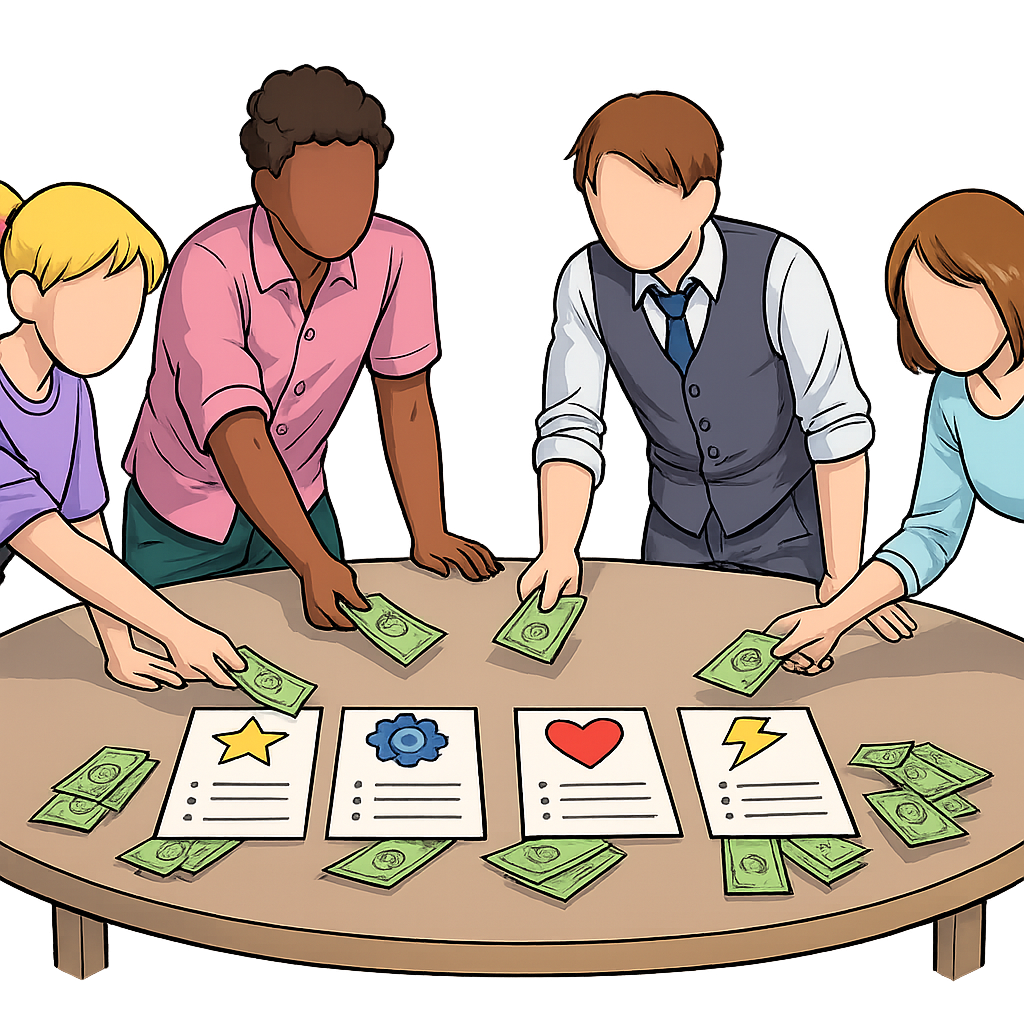
Buy a Feature is an Innovation Game developed by Luke Hohmann where participants receive a limited budget of play money and must decide which features to purchase from a priced list. By giving each participant only enough money to buy one-third to two-thirds of the available features, the exercise introduces economic scarcity that forces genuine trade-offs. The most revealing dynamic occurs when expensive features require multiple participants to pool their money, sparking negotiation and coalition-building that surfaces true priorities and the reasoning behind them.
The conversations that happen during the game — the debates, the compromises, the lobbying — are as valuable as the final purchasing decisions. These conversations reveal not just what customers want, but why they want it and how much they are willing to sacrifice for it.
Common Use Case
You have a backlog of fourteen to thirty candidate features and a small group of target customers you can convene for sixty to ninety minutes. You need to know which features they would actually pay for, not just rate as “important” on a survey. The output is a ranked-by-budget feature list plus the negotiation reasoning customers used to get there.
Helps Answer
- Which features would customers actually pay for?
- How do customers make trade-offs between features?
- What is the perceived relative value of different features?
- Are there features that only specific segments care about?
- What coalitions form around which features?
Description
Buy a Feature works by introducing the core mechanism of economic decision-making: scarcity. In real markets, customers cannot have everything — they allocate limited resources toward their highest priorities. By simulating this constraint with play money, the game produces behavior that mirrors real purchasing decisions far more closely than any rating scale or ranking exercise.
The design of the game creates three distinct layers of insight:
- Individual priorities. What each participant chooses to buy with their own money reveals their personal must-haves.
- Negotiation behavior. When expensive features require pooling money, participants must persuade others to join them. The arguments they make and the compromises they accept reveal the depth of their commitment.
- Feature abandonment. What participants choose not to buy — even when they could afford it — reveals features that sound nice but are not worth the trade-off.
How to
Prep
1. Build the feature list.
Write fourteen to thirty candidate features on cards, a poster, or a handout. Each feature gets a clear name, a one-sentence description, and a price. Hohmann’s Innovation Games recommends keeping the list in this range — long enough to force trade-offs, short enough that participants can hold the whole set in their head. Use customer-facing language, not internal codenames.
2. Set prices to provoke trade-offs, not to model engineering cost.
Pricing is the single most important design choice. Hohmann’s rule: at least one or two features should be priced high enough that no single customer can buy them alone. That forces coalition-building, which is where the richest insight lives. ProductPlan’s practitioner glossary frames the same rule qualitatively — features should be priced to push customers into negotiation, not to teach them about your engineering effort.
A workable distribution for a fourteen-to-thirty feature list:
- Five to ten low-priced features that any participant can afford.
- Five to twelve medium-priced features that require trading off other purchases.
- Four to eight high-priced features that require two to four participants to pool money.
Use round numbers so participants can do the math in their heads.
3. Distribute play money.
Each participant receives the same budget — enough to buy roughly one-third to two-thirds of the total feature value if they spent only on cheap features. Hohmann’s original framing: scarcity is the mechanism that produces honest signal, so the budget must be tight enough that participants cannot have everything. Print bills, use poker chips, or hand out paper certificates — whatever holds up to being passed back and forth on a table.
4. Recruit four to seven participants per group.
Hohmann recommends four to seven customers per group: small enough that everyone has to talk, large enough that coalitions can form. UX for the Masses’ practitioner walkthrough echoes the same range. Run multiple groups if you have access to more than seven customers — convergent results across groups carry far more weight than a single session.
5. Draft the rules sheet.
Write the rules out so the facilitator can read them verbatim. The core rules:
- “You have $X to spend on the features in front of you.”
- “You can buy any feature you can afford on your own.”
- “You can pool money with other participants to buy a feature together.”
- “You do not get change. Leftover money has no value.”
- “You have forty-five minutes.”
Execution
1. Open with the rules and the budget reveal.
Read the rules verbatim from the sheet you drafted in Prep. Hand out the play money in front of the group so the budget feels tangible. Take ten minutes for introductions and rules so participants understand the mechanic before any money moves.
2. Step back and let them play.
Once the rules are clear, the facilitator’s job is to observe, not to guide. The “magic of negotiation” — Hohmann’s phrase from Innovation Games — only happens if participants believe they have to convince each other. Do not validate choices. Do not explain features beyond the printed description. If a participant asks what something means, note the confusion as a finding and redirect them to the description on the card.
Forty to sixty minutes is the right window for purchasing and negotiation. Take notes on who approaches whom, what arguments get made, what deals get struck, and what features get abandoned without discussion.
3. Track purchases as they happen.
As participants finalize purchases, record:
- Which features were bought.
- Who paid for each feature, and how much each contributor put in.
- Which features were purchased through pooled money, and which participants formed the coalition.
A simple spreadsheet column for each feature works fine. If you are running the session remotely, a shared board (Miro, FigJam) lets participants drag chips onto features while you log the same data.
4. Debrief for fifteen to twenty minutes.
After time is up, walk the group through the results. The high-leverage questions:
- “What was the hardest trade-off you made?”
- “What feature did you want but decided not to buy? Why?”
- “What surprised you about other people’s choices?”
The reasoning that comes out of the debrief is often more useful than the purchase data itself.
Analysis
Analyze results across several dimensions:
- Most-purchased features are clear priorities. If a feature was bought across multiple groups, it is a strong roadmap candidate.
- Features that inspired pooling are aspirational and high-value. These often represent capabilities that could become key differentiators — and the negotiation around them tells you which segments will fund them.
- Features no one bought are candidates for cutting from the roadmap, regardless of how much engineering effort has already been invested.
- Negotiation patterns reveal segment dynamics. If certain participants consistently lobbied for the same features, they may represent a distinct customer segment with shared priorities.
- Leftover money tells you about satisfaction with the available options. If participants consistently had unspent money at the end, the feature list may be missing something important — go back to generative interviews to find it.
- Dominant negotiators Assertive participants may drive group purchasing decisions. Observe whether quieter participants were genuinely persuaded or merely yielding. Ask each participant to privately write down their top three before the game begins so you can compare individual intent against group outcome.
- Price anchoring Participants may equate higher price with higher value, rather than making independent judgments. Remind the group at the start that prices are for gameplay only, not signals of importance or quality.
- Coalition pressure Once a coalition forms around an expensive feature, participants may feel social pressure to contribute even if it is not their top priority. Watch for reluctant contributions and probe them in the debrief.
- Feature framing How features are named and described significantly affects purchasing behavior. Use customer language and pilot the feature list with one or two customers before the real session.
- Unequal information Some participants may understand certain features better than others, giving them outsized influence. Make sure each description is clear enough that the least-informed participant can evaluate it.
Learn more
Case Studies
Capital One
Used Buy a Feature to prioritize a new tool for retail bankers, deliberately surfacing the gap between front-line bankers (who wanted features that helped them serve customers) and executive management (who wanted process-efficiency features). The team ran it as an online $100-allocation across both audiences and used the high-value/low-effort intersection to scope the MVP, deferring the rest to later releases.
City of San José
Adapted Buy a Feature into “Budget Games” with Luke Hohmann’s team to let roughly 300 residents allocate a ~$64M city maintenance and beautification budget across 30 projects, where every increase forced an offsetting cut elsewhere. Officials reported the forced trade-offs produced “actionable consensus” they could act on with more confidence than traditional polling, and the program ran annually from 2011 onward.
Further reading
- Hohmann, Luke. Innovation Games: Creating Breakthrough Products Through Collaborative Play. Addison-Wesley, 2006. The primary source for the Buy a Feature mechanic, including the pricing rule, group-size guidance, and budget design.
- Buy a Feature — Luke Hohmann
- Buy-a-Feature — ProductPlan
- How to play the “Buy a Feature” design game — UX for the Masses
- Innovation game — Wikipedia
Got something to add? Share with the community.