Can Synthetic Personas Replace Customer Discovery? An Honest Look
LLM personas replicate 76% of known effects but can't surface what you don't know. Here's the research scorecard and a framework for using them well.
Customer discovery and experimentation are how we replace assumptions with evidence. This guide covers the full cycle: from asking the right questions to designing experiments that actually reduce risk.
Explore Training ProgramsQuick Answer: Customer discovery is the process of talking to real people to test whether our assumptions about their problems, behaviors, and willingness to pay are actually true. Experimentation extends that process beyond interviews into structured tests — landing pages, prototypes, concierge services — designed to produce evidence we can act on. The goal isn’t to confirm what we already believe. It’s to find out where we’re wrong before we spend the money building something nobody wants.
A product team spends six months building a feature that customers asked for in a survey. They launch it. Almost nobody uses it. The post-mortem reveals that customers said they wanted it because the survey question was leading, and the team never tested whether people would actually change their behavior.
That’s a discovery failure, not a product management failure. The team skipped the part where we find out if the problem is real, if people actually do what they say they’ll do, and if the proposed solution changes anything.
Customer discovery and experimentation are the disciplines that prevent this. They’re often framed as “practitioner skills” — things for product managers and startup founders to learn. That’s true. But the implications are strategic. When an innovation portfolio is full of projects that skipped discovery, the portfolio looks like a collection of expensive guesses. When projects do run proper discovery, the evidence they generate feeds directly into the innovation accounting system and gives leadership the information they need to make good investment decisions.
For a concise overview of the full lean methodology, The Ultimate Guide to Running a Lean Startup covers the big picture.
The most important (and most commonly botched) customer discovery technique is the interview. Not a survey. Not a focus group. A one-on-one conversation designed to understand how someone actually experiences a problem in their daily life.
Good customer interviews are hard. The instinct is to describe your solution and ask “would you use this?” The answer is always yes, because people are polite. That tells you nothing.
The real skill is asking about past behavior, not future intentions. “Tell me about the last time you dealt with [problem].” “What did you do?” “What happened next?” “What did that cost you?” These questions reveal how people actually behave, not how they think they’d behave in a hypothetical scenario.
Three resources for getting this right:
And if you’re making the classic mistakes, Top 3 Ways to Fail at Customer Development is a quick gut-check.
One question we get frequently: is customer discovery ever done? The short answer is no — but the intensity changes. Early-stage discovery is heavy (talking to people every day). Once core assumptions are validated, discovery shifts to monitoring and edge-case exploration. The key is having clear criteria for what “validated” means before you start.
Interviews tell us about problems. Experiments tell us about solutions.
An experiment is a structured test designed to reduce uncertainty about a specific assumption. Not “will people like our product?” (too vague), but “will at least 10 percent of visitors to this landing page click the signup button?” (testable, with a clear pass/fail criterion).
Good experiment design starts with identifying the riskiest assumption — the one that, if wrong, would invalidate the entire business model. Then designing the cheapest, fastest test that produces enough evidence to make a decision about that assumption.
The test doesn’t need to be sophisticated. Some of the best experiments we’ve seen were:
What matters is that the experiment has a hypothesis (what we expect to happen), a metric (how we’ll measure it), and a threshold (what result would change our decision). Without all three, it’s not an experiment. It’s just messing around.
For the practical framework, What Type of Lean Startup Experiment Should I Run? helps match the experiment type to the assumption being tested. For quantitative rigor, Rules of Thumb for Quantitative Experiments covers sample sizes, significance, and common statistical traps. And for how to document experiments so the learning is reusable, see our lean experiment template (yes, the title is a warning on purpose).
Discovery and experiments produce evidence. But evidence doesn’t make decisions for us. We still have to interpret what we learned and decide what to do next.
This is where most teams stumble. They run an experiment, get ambiguous results, and either ignore them (continuing to build what they planned to build) or over-react to a single data point (pivoting based on one customer’s opinion).
The discipline is in the decision criteria. Before running an experiment, we should agree on what results would lead to each possible outcome: continue on the current path, pivot to a different approach, or kill the project entirely.
In practice, this is where things get messy. We get attached to our ideas. We fall in love with our vision. Saying “the data says this isn’t working” is easy in theory and brutally hard in a room full of people who’ve spent six months on the project. This is why having the criteria before the data matters — it short-circuits the emotional gymnastics.
For a method to triangulate across multiple data sources rather than relying on any single experiment, read that guide. For the practical mechanics of how speed beats perfection in experimentation, especially for teams that tend to over-engineer their tests.
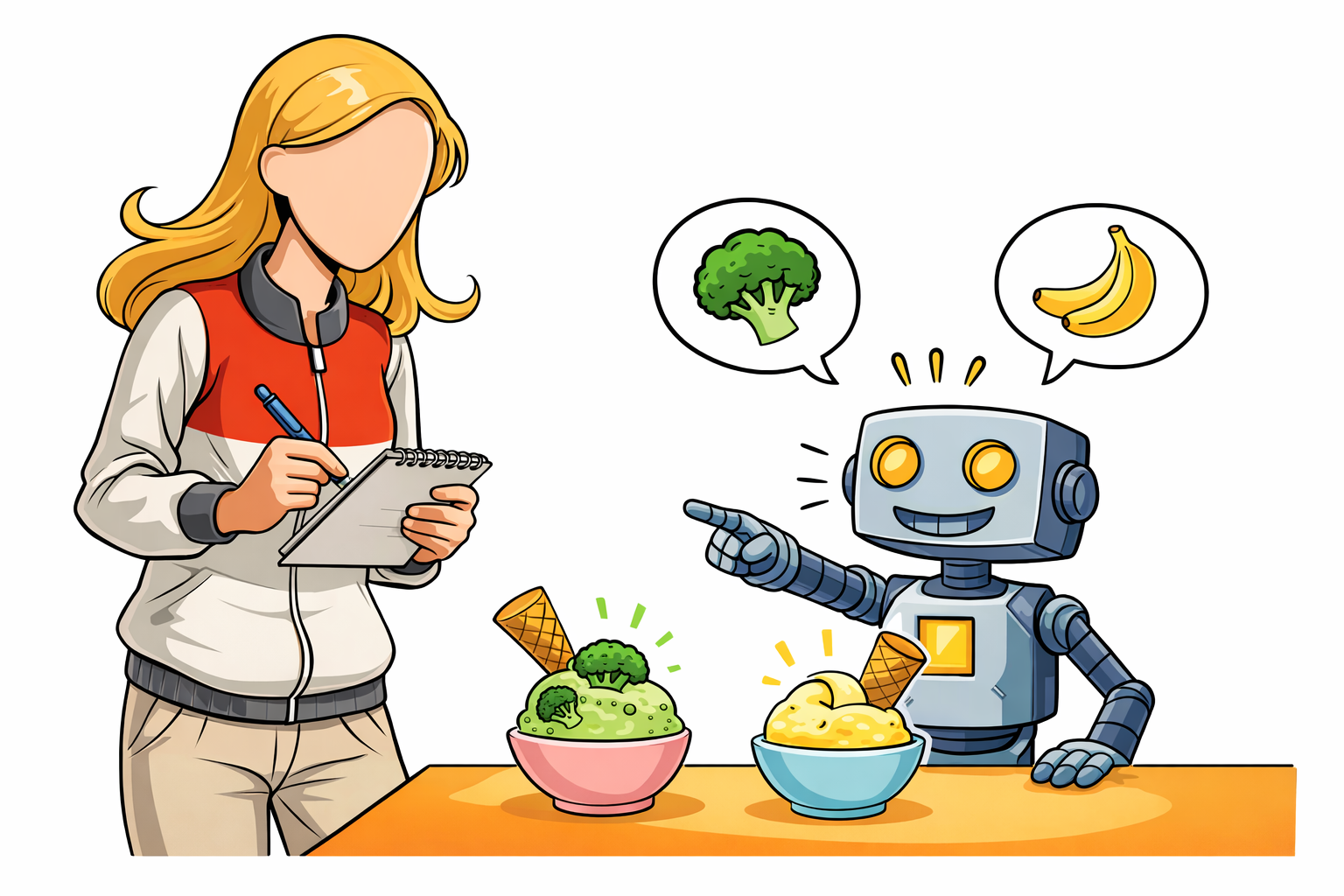
AI is changing how we do discovery, but it hasn’t replaced the fundamentals. Tools like synthetic personas can simulate customer conversations, generate hypotheses, and help prepare for real interviews. But they can’t replace the actual interview.
Why not? Because AI-generated “customers” reflect patterns in training data, not the messy reality of how a specific person in a specific context actually behaves. Synthetic personas are useful for preparation — generating a range of responses to stress-test your interview guide. They’re dangerous when used as a substitute for real conversation.
We explored this tension in depth in Can Synthetic Personas Replace Customer Discovery?. The honest answer: they can accelerate the process, but they can’t replace it.
Asking “would you use this?” instead of “what did you do last time?” Future-tense questions produce unreliable answers. Past behavior is the best predictor of future behavior. Every customer interview should be grounded in what people actually did, not what they say they’d do.
Running experiments without clear success criteria. If we don’t know what result would change our decision, the experiment is a waste of time and money. Define the hypothesis, metric, and threshold before collecting any data.
Treating customer discovery as a phase instead of a practice. Discovery isn’t something we do once at the beginning and then stop. It’s an ongoing practice that changes in intensity but never goes away. The best product teams talk to customers every week, even after product/market fit.
Customer discovery and experimentation are not “soft skills.” They’re the primary mechanism for reducing risk in innovation projects. Every assumption we validate is one less thing that can blow up later. Every one we skip is a bet… and most of us aren’t as lucky as we think.
Start with interviews. Get comfortable with the discomfort of hearing things you didn’t expect. Then graduate to structured experiments with clear criteria. And connect the evidence back to your innovation accounting system so leadership can see the progress.
Want to build your team’s discovery and experimentation skills? Our training programs cover customer interviews, experiment design, and innovation accounting for corporate teams. Explore programs.
There’s no magic number, but five to eight interviews on the same topic usually reveal the major patterns. If you’re hearing the same themes from five different people, you have enough signal to form a hypothesis. If every interview surfaces something completely different, you need more. The goal isn’t statistical significance — it’s pattern recognition. For quantitative validation, switch to experiments with larger sample sizes.
Customer discovery focuses on problem validation — finding out if the problem is real, painful, and frequent enough to build a business around. User research typically focuses on solution optimization — making an existing product easier to use. Both involve talking to people, but the questions are different. Discovery asks “do you have this problem?” and “how do you currently deal with it?” User research asks “can you complete this task?” and “where do you get stuck?” Most teams need both, but discovery comes first.
Frame it as risk reduction, not process overhead. Every week spent on discovery is a week not spent building something nobody wants. If a $500,000 development project has a 60 percent chance of failure without discovery and a 20 percent chance with it, the expected value of discovery is $200,000 in avoided waste. That’s a conversation executives understand. Connect discovery outputs to your innovation accounting metrics so leadership can see evidence of progress.
32 articles
LLM personas replicate 76% of known effects but can't surface what you don't know. Here's the research scorecard and a framework for using them well.
AI can accelerate ideation and prototyping, but outsourcing creativity risks mediocrity. Learn to use AI-driven innovation without losing your edge.
Community innovation delivers stronger returns when financial and social ROI work together. Learn how to innovate with communities and where AI fits in.
Innovation failure stems from missing strategy, resources, and scale — not poor training. Learn how to integrate methods into a complete innovation stack.
Use artificial intelligence in innovation as a creative collaborator, not a replacement. Delegate mundane tasks to AI and focus on what humans do best.
Most product managers misuse statistics. Learn how margin of error, sample size, and experiment design lead to better product decisions.
Learn 3 innovation perspective games — Six Thinking Hats, Role Storming, and Reverse Brainstorming — to unlock disruptive ideas and break creative ruts.
Learn how innovation teams can drive measurable ROI through focused project briefings, customer personas, and innovation accounting practices.
Learn how to build a Monte Carlo simulation that turns uncertain business assumptions into actionable forecasts with ranges and distributions.
Learn five proven guesstimation techniques — from Fermi Decomposition to equivalence bets — to make smarter decisions when hard data doesn't exist.
Learn how to make a pivot or persevere decision using success criteria and fail conditions. Discover all four outcomes: scale, persevere, pivot, or kill.
Learn five strategies for using learning and development to build a culture of innovation, from engaged leadership to hiring for diversity.
Averaging best and worst case outputs overestimates ROI due to non-linear math. Learn why Monte Carlo simulation works better.
Business model innovation demands outside perspectives to spot hidden flaws. Learn why diversity of viewpoint matters more than expertise.
Data mining can swallow you in a void of ones and zeros. Use the CCE framework to find correlations, determine causation, and verify with experiments.
Data mining can swallow you in a void of ones and zeros. Use the CCE framework to find correlations, determine causation, and verify with experiments.
70% of digital transformations fail. Learn why exponential transformation — not just digitizing processes — is what actually drives growth.
Grab the Kromatic Disruptive Idea t-shirt designed by Amos Ostos. A wearable conversation starter made for innovation nerds who challenge the status quo.
Retention rate measures customers kept over time — but it's a growth amplifier, not an engine. Learn the formula and when to persevere, pivot, or kill.
Good innovation governance means deciding early, not waiting for perfect information. Earlier pivots are dramatically cheaper. Here's why.
Entrepreneurs beat procrastination by removing friction before creative work. Break tedious setup into small chunks and do them the night before.
Lean startup certification is already happening — mostly badly. Here's what real certification should look like and why experience beats attendance.
Lean startup certification is already happening — mostly badly. Here's what real certification should look like and why experience beats attendance.
We accidentally spammed our subscribers and found unexpected benefits. Learn our 3-step mistake recovery process: STOP, fix it, find the root cause.
We accidentally spammed our subscribers and found unexpected benefits. Learn our 3-step mistake recovery process: STOP, fix it, find the root cause.
Startups are poker, not chess. Learn how to gather market intelligence, pivot your business model, and avoid going all-in on untested assumptions.
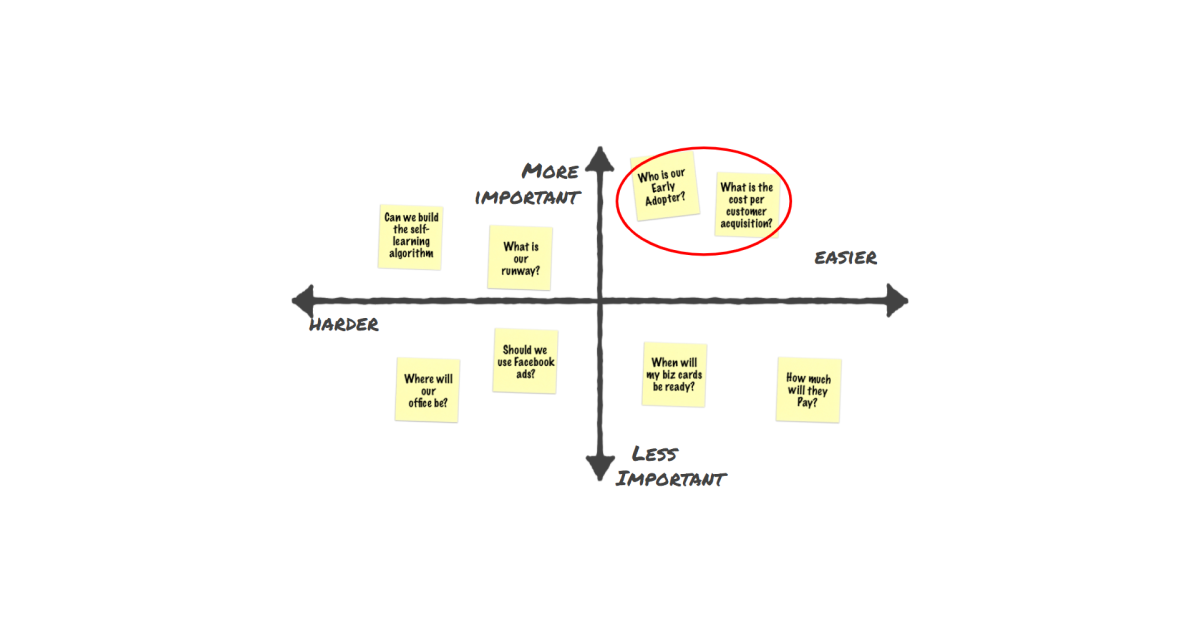
Learn how to properly fill out a 2x2 risk prioritization matrix using relative axes, fast placement, and deprioritization to find your one top priority.
When you can't get out of the building, adopt a hacker mindset. Creative tactics for customer validation during lockdowns and remote work constraints.
Learn how to analyze customer discovery interview data by tagging themes, finding patterns, and using informed intuition to move fast.
Build a customer discovery template with a clear learning goal and four note types: quotes, observations, body language, and misc. Prep better, learn more.
Learn what an MVP really is, why it's not always a product, and get templates to define and test your most critical business model assumptions.
Learn what an MVP really is, why it's not always a product, and get templates to define and test your most critical business model assumptions.