

AI Innovation Strategy: Why Technology Alone Isn't a Strategy
Stop measuring AI pilots like capital projects. Measure the loop.
 By Tristan Kromer ·
 Quick Answer: An AI innovation strategy isn’t about deploying AI tools — it’s about applying AI to accelerate your innovation methodology. That means using AI to compress the cost and speed of experimentation and measuring experiment economics first — cost per experiment, throughput, time to validated learning. ROI still matters; your CFO will want to see it. But the learning loop has to come first. Companies failing at AI aren’t failing because the technology doesn’t work. They’re failing because they’ve mistaken a technology for a strategy.
Most enterprise AI programs are failing. Not because AI doesn’t work. It does…frighteningly well in some instances…frighteningly badly in others. I’ve seen first hand how effective AI can be at writing code (better and faster than I can) and I’ve also seen it fail miserably at basic questions. (Try asking, “I want to wash my car. The automatic car wash building is only 50 meters from my home. Do you think I should walk there, or drive there?” Use Cuey to compare the answers to different models.) AI projects are failing because they’re evaluated like capital projects. “Where’s the ROI?” “Show me the cost savings of replacing 10 workers or the project is killed.” That framing of AI as cost reduction destroys the exact behavior that makes AI valuable: rapid, cheap experimentation. The companies pulling ahead aren’t tracking revenue from AI pilots — they’re tracking cost per experiment, time to validated learning, and experiment throughput. When you measure what AI actually does to your innovation economics, the strategy becomes obvious.
Every Technology Wave Gets Mistaken for a Strategy
 We’ve been here before. When the internet arrived, every company needed a “website strategy.” When mobile took off, every company needed an “app strategy.” (I don’t need the corner bodega to have their own delivery app.) Now every company needs an “AI strategy.” The language is identical. The mistake is identical. Having a website was never a strategy. Neither was having an app. The companies that won the internet era weren’t the ones that built the most elaborate websites — they were the ones that redesigned their operations around what the internet uniquely made possible. Think Amazon and Netflix. The companies that failed in the mobile era built apps first and asked “why?” second. Quibi raised $1.8B, built proprietary mobile technology, and shut down six months after launch. They had the technology but they never had the answer to “why would someone pay for this?” AI is following the same script. According to S&P Global, 42% of companies abandoned most of their AI initiatives in 2025 — up from 17% in 2024. Most of those initiatives died in the same place they started: with a technology looking for a problem. I’m usually not one to protest killing projects that aren’t delivering — it’s part of a good Pivot or Persevere decision. But this failure rate is something else. This is asking the wrong question. The question that drives a real strategy isn’t “how do we deploy AI?” It’s “what does AI make possible that we couldn’t do before, and how do we build an organization that can exploit that?”
AI Is a Technology, Not a Methodology
 This is a category failure. Lean startup, design thinking, and agile are methodologies — structured ways of making decisions and validating learning. They answer the question: how do we build and test things systematically? AI is a technology — a capability to accelerate those, not replace them. Conflating the two is the root cause of the 80%+ enterprise AI pilot failure rate documented by RAND and others (MIT puts the figure as high as 95%). When a company says “our strategy is AI,” they haven’t answered any strategic question. They’ve identified a tool. That’s roughly equivalent to saying “our strategy is spreadsheets.” The distinction matters because methodology is the hard part. Most companies don’t fail at AI because the models perform poorly. They fail because they have no method for identifying which problems deserve to be solved. They have no process for validating whether AI solves those problems and no system for learning fast enough to adjust when it doesn’t. AI amplifies whatever methodology is already in place. If the methodology is weak — if experiments are slow, learning is diffuse, and success metrics are contested — AI makes that weakness more expensive, not less.
What AI Actually Changes: The Economics of Experimentation
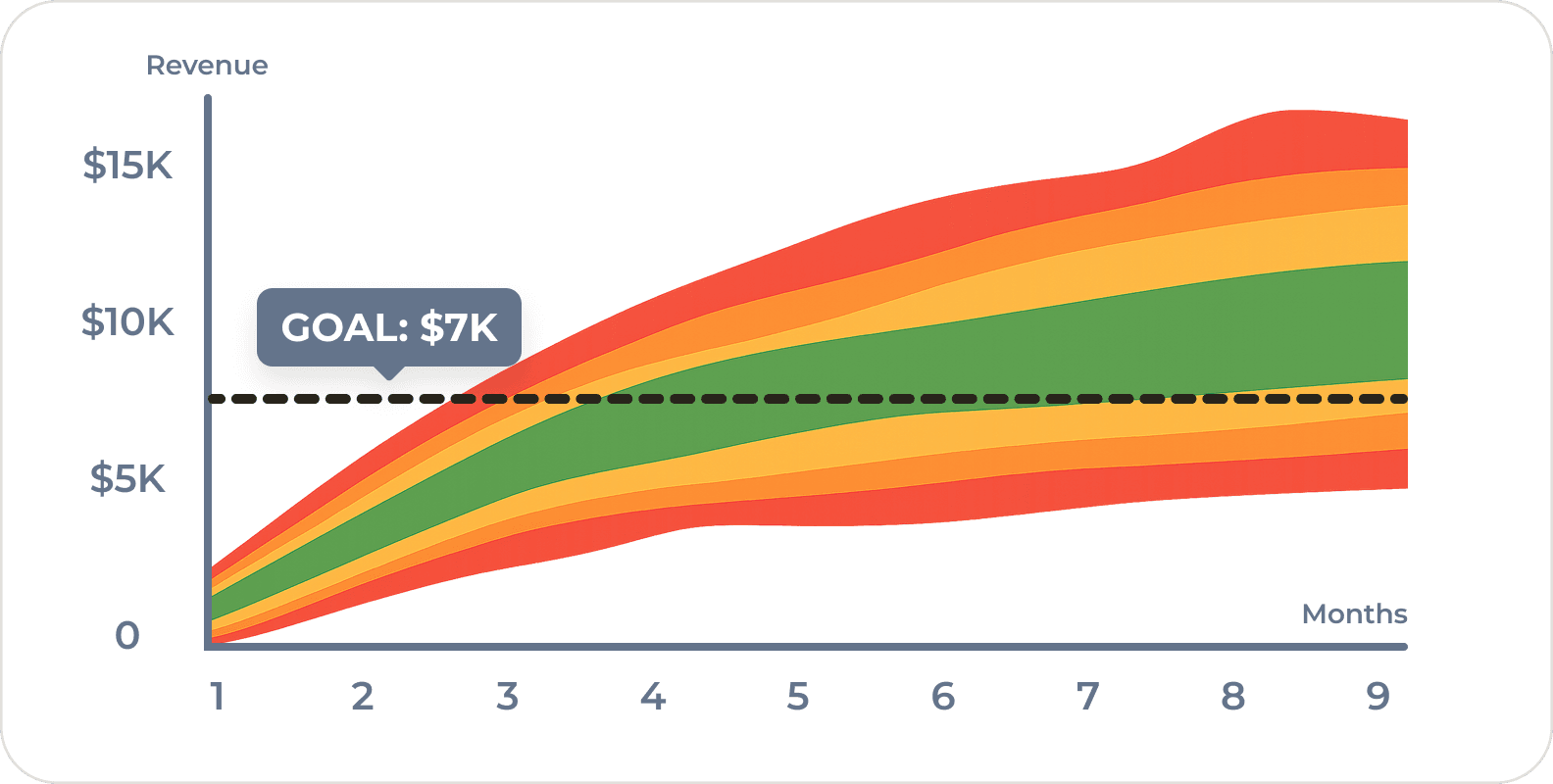
 When AI is applied inside a rigorous innovation methodology, the numbers shift radically. AI inference costs dropped roughly 280× in 18 months — from around $20 to $0.07 per million tokens for GPT-3.5-equivalent performance, according to the Stanford AI Index and Epoch AI. McKinsey’s research on enterprise agility found that agile transformation alone reduces time-to-market by at least 40% — and AI-assisted development adds a further 20–45% productivity gain on top of that. Customer discovery synthesis that used to take days takes hours. The unit economics of a single experiment have improved by an order of magnitude. The cost of learning has dropped. The time to a validated insight has compressed. This is the argument for sequencing how we measure AI’s contribution to innovation. ROI still matters — your CFO needs to know there’s gold at the end of the rainbow, and rigorous forecasting (a.k.a Innovation Accounting using Monte Carlo Analysis) is the right tool for that conversation. But demanding ROI from the first experiment kills the learning loop before it gets started. The leading indicators that tell you whether the build-measure-learn loop is working are cost per experiment, experiment throughput, and time to validated learning. When those numbers are moving in the right direction, the revenue follows. Measure the loop first.
So What Is an AI Innovation Strategy?
 If you’re the Head of Product or VP of Innovation, it’s not your job to shove AI in everyone’s face and call that an “AI first strategy.” An AI innovation strategy is a deliberate plan for applying AI to your innovation methodology to compress learning cycles. Not “deploy AI.” Not “become an AI company.” Not “build an AI roadmap.” Compress learning cycles. Measure the compression. Adjust. In practice, this means three things. First, identify where your methodology is slowest. Customer discovery? Prototype development? Synthesising what you learned from the last round? That’s where AI has the highest leverage — not where AI is most impressive, but where the learning bottleneck currently sits. Second, start measuring experiment economics. Cost per experiment, experiment throughput, and time to validated learning are the leading indicators of innovation health. These are the metrics that tell you whether AI is actually accelerating your methodology — before revenue shows up to confirm it. Third, forecast the ROI — don’t wait for it. Your CFO needs to know there is gold at the end of the rainbow, and “we’re running more experiments” isn’t a sufficient answer. But, “we cut the cost of deploying an MVP by 50%,” starts to sound like ROI. Using innovation accounting to forecast the expected return of your portfolio sounds even better. Showing how each experiment reduces the uncertainty of your predictions and allows you to make data-driven Pivot or Persevere decisions is even better. “We ran 40% more experiments at 60% lower cost, our validated learning rate is up, and here is our forecast for portfolio return over the next 18 months.” That’s a story that will keep your team funded. “Our AI pilot showed promising results” is a story that gets cut. An AI innovation strategy isn’t really about AI. It’s about the innovation methodology that AI makes faster, cheaper, and more defensible — with the learning loop and the ROI forecast working together.
Five Places to Start Increasing Experiment Velocity
 So where can you plug AI in to accelerate velocity? Here are five places you can get started today:
1. Build a RAG of your experiment history
Most organizations run the same experiments repeatedly because institutional memory lives in slide decks no one opens. A retrieval-augmented system over your past experiments and insights means your next team doesn’t start from zero — they start from validated learning. The experiment loop compounds instead of resetting.
2. Deploy an agent to review experiment design before you run it
A well-designed experiment is the difference between action and debate. An AI agent trained on good experimental design principles — clear hypothesis, falsifiable fail condition, defined success metric — can catch design flaws before they cost you time and money. It’s a coach and bayesian statistician on demand.
3. Use AI to interpret and critique experiment results
Humans are biased. Badly. AI can also be biased, but not if well prompted (and if you avoid Grok). AI can flag when a result is being over-interpreted or when the sample size doesn’t support the conclusion being drawn.
4. Try synthetic personas for early-stage idea pressure-testing
Before you spend time recruiting interview participants, an AI built on your customer research can simulate how your target persona would respond to a new concept. It doesn’t replace real customer conversations — nothing does — but it can help us kill obviously weak ideas faster and arrive at real interviews with sharper hypotheses.
5. Automate your innovation accounting
Calculating ROI under situations of extreme uncertainty are exactly what humans are terrible at. Using AI to help you forecast outcomes is a massive improvement over the best / worst case spreadsheets that the finance team suffers through. You can use tools like Krobar.ai to generate business model forecasts quickly.
None of these require a large AI infrastructure investment. Most can start as lightweight internal tools. The point is to pick one bottleneck, apply AI to it, measure the compression, and let the learning loop demonstrate its own value. If you’re not sure where to start, this post covers some tactical details.
Frequently Asked Questions
What is an AI innovation strategy?
An AI innovation strategy is a plan for applying AI to your innovation methodology to compress learning cycles and reduce the cost per experiment. It is not a plan to deploy AI tools across the business. The distinction matters: a technology deployment without a methodology for learning is just expensive guessing with faster processors.
Why are most enterprise AI projects failing?
Most enterprise AI projects fail because they’re evaluated as capital investments — judged on near-term ROI or cost savings — rather than as experiments designed to generate validated learning. S&P Global found that 42% of companies abandoned most AI initiatives in 2025, up from 17% the year before. The failure isn’t the technology. It’s the measurement framework applied to it.
Is AI a methodology or a technology?
AI is a technology. Lean startup, design thinking, and agile are methodologies. Methodologies answer the question of how to make decisions and validate learning. AI accelerates those methods. Treating “AI strategy” as a substitute for a rigorous innovation methodology — rather than a complement to one — is the category error responsible for most AI program failures.
How do you measure AI innovation success?
Start by measuring experiment economics: cost per experiment, experiment throughput, and time to validated learning. These are the leading indicators of a healthy innovation loop, and they’re what AI most directly affects. ROI still matters — your CFO will want to see it, and rigorous innovation accounting can help you forecast portfolio return even before revenue arrives. The mistake is demanding ROI from experiment one, before the learning loop has had time to run. Sequence it right: measure the loop, forecast the return, report both.
What’s the difference between having an AI strategy and an AI innovation strategy?
An AI strategy describes how a company will adopt and deploy AI across its operations broadly. An AI innovation strategy is narrower: it describes how AI will be applied specifically to the innovation process — to accelerate experimentation and reduce the cost of learning. Most companies that claim to “have an AI strategy” have the first. Very few have the second. If you’re navigating the pressure to show AI’s contribution to your innovation program — and need to make that case to a CFO, board, or leadership team who still wants to see ROI — executive coaching might be the right conversation. We work with heads of innovation and product leaders at the VP and director level who are building that argument from the inside.

Comments
Loading comments…
Leave a comment