
How to Build a Minimum Viable Product: The 4 Parts You Need
Hint: a landing page with signups isn't one of them.
 By Tristan Kromer ·
 How to Build a Minimum Viable Product- (This is part of a series of posts about testing product/market fit. You can download the Product/Market Fit Storyboard here.) 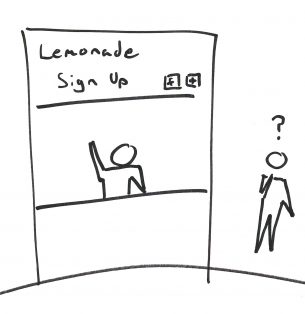 The terms Product/Market Fit and Minimal Viable Product have been inexplicably (and inextricably) linked in the tech consciousness. If people sign up for our MVP, that means we’ve got Product/Market Fit, right? Nope. As we discussed last week, Product/Market Fit is as much about being ready to scale as it is about having a desirable product. If our MVP is just smoke test, a landing page just to test customer demand, certainly you’re not ready to scale. (Frankly, calling most smoke tests an MVP is a serious stretch. We tend to forget that the ‘V’ stands for Viable.) If our MVP is a Wizard of Oz test where you manually provide the service, you may not be ready to scale, but you may have a strong indication it’s time to build a little bit more. So what’s in an MVP and how to build a minimum viable product?
An MVP is not just the Product
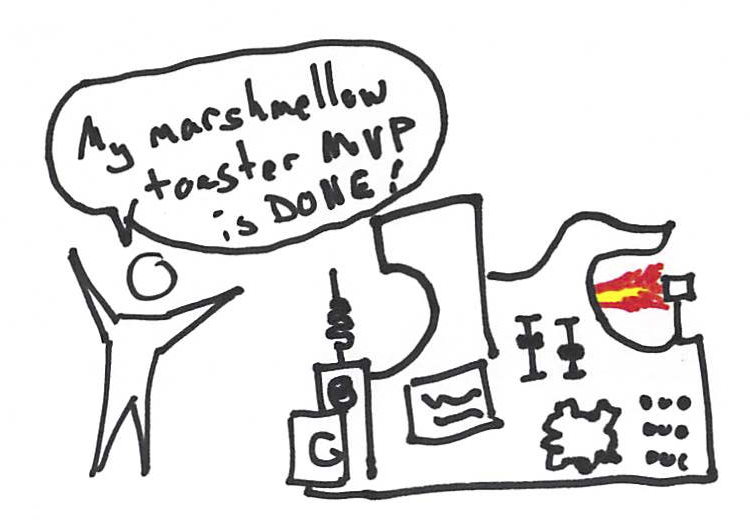 An MVP isn’t just a bunch of features tied together.
Quick Answer: An MVP isn’t just a stripped-down product—it’s a complete Build-Measure-Learn loop with four critical parts: Customers, Value Proposition, Channels, and Relationship. As product managers, we need channels to deliver value to customers and a relationship mechanism to collect feedback from them. Without this closed loop, we’re just shipping features and learning nothing. And no, signups on an MVP don’t mean Product/Market Fit—that requires being ready to scale, not just having demand.
The minimum viable product is that version of a new product which allows a team to collect the maximum amount of validated learning about customers with the least effort. - Eric Ries, The Lean Startup
If we build a product, even the perfect product, we learn nothing. If we build our MVP, with just the right amount of features to make our early adopters squirm with delight, something is still missing. How do we get the product to those early adopters? As Steve Blank says, validated learning comes from outside of the building. Without customers, we learn nothing and our MVP fails. And if we have customers? What then? If 10,000 people download our MVP, does that help us? Are we collecting feedback?
The Four Parts of a Minimal Viable Product
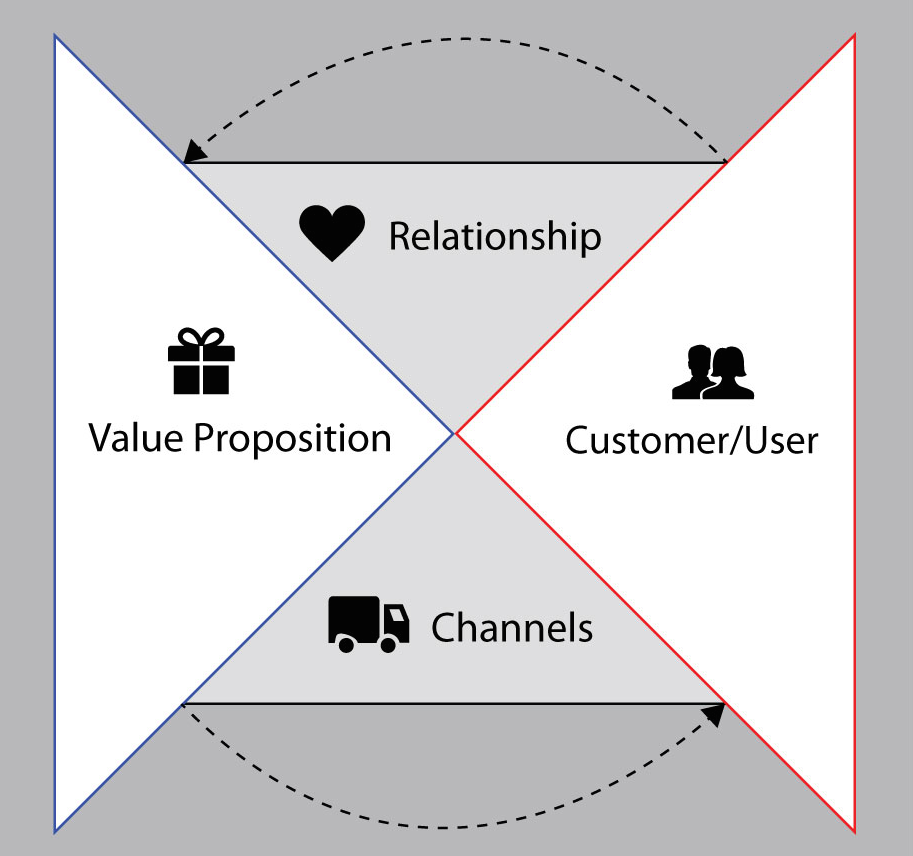
So an MVP is more than a product, it’s a route to learning. We build an MVP in order to take a small step towards Product/Market Fit and each step must be a complete Build-Measure-Learn loop. For an MVP, this means we need a minimum of four parts:
- Customers
- Value Proposition
- Channels
- Relationship
These components are directly from the Business Model Canvas by Alexander Osterwalder and represent how we deliver Value to the Customer via Channels and collect feedback via our Relationship.
Closing the Loop
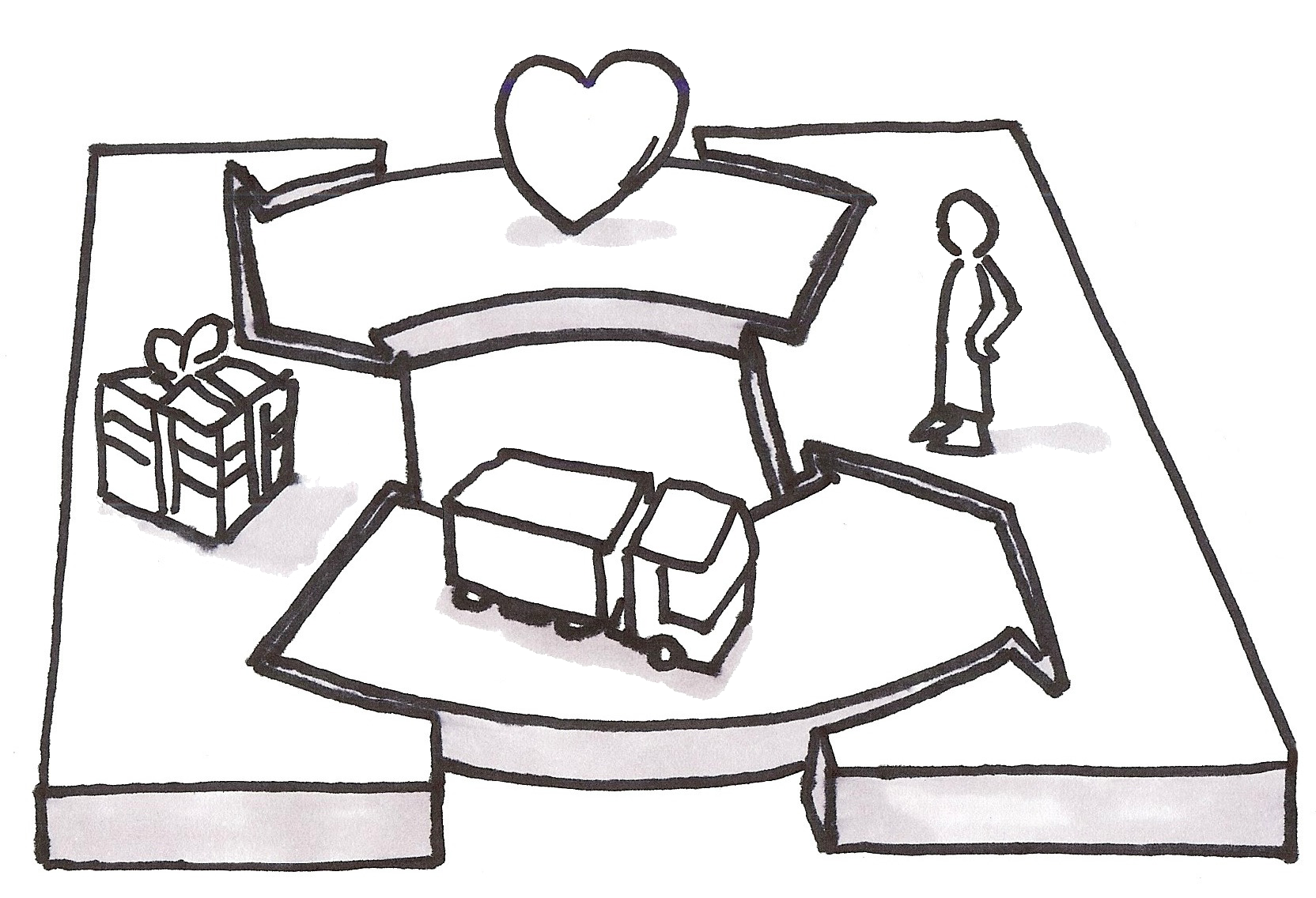 On the Product/Market Fit Storyboard, we’ve started with the pieces of the Business Model Canvas, but the shape is a bit different. We’ve flipped the direction of the arrow on the Customer Relationship, because here at the early stages of development, our Relationship is not about delivering value to the Customer. It’s about the Customer delivering feedback to us so we can modify the Value Proposition. This gives us a loop that roughly corresponds to Build-Measure-Learn. We’ll have to:
- Build our Value Proposition and Channels,
- Measure our Channel’s effectiveness and our Customer’s reactions,
- and Learn from our Relationship to come up with a better Value Proposition.
Focusing on Product/Market
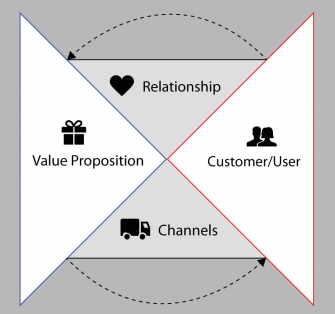 Since we’re focused on Product/Market Fit prior to scaling, we won’t be testing our marketing Channels and Relationship so they’re a bit greyed out on the storyboard. For the Product/Market Fit Storyboard, Channels & Relationship are temporary hypotheses which may be entirely different to your overall Business Model Canvas. We’ll only build a sufficient Channel to reach our first few customers. When we need more, we’ll scale up our Channel accordingly. Our first channel may be just inviting 10 people directly on LinkedIn. Similarly, we won’t be establishing scalable Relationship. In fact, we want the highest quality Relationship as possible. So we’re just looking for a qualitative Relationship where we actually get to talk to the Customer.
Next Steps
In the next few posts, I’ll go into the details of creating useful hypotheses for each of these four blocks. If you’d like to jump ahead and get quick feedback, fill out the storyboard and tweet me an image. If you’d like more hands on help, I’ll trade some of my time for some of yours in improving the Storyboard. First three startups can contact me here for details.
Frequently Asked Questions
How do you build a minimum viable product the right way?
To build a minimum viable product properly, we need four critical parts: Customers, Value Proposition, Channels, and Relationship. An MVP isn’t just a stripped-down product—it’s a complete Build-Measure-Learn loop. We build our value proposition, deliver it through a channel, and collect feedback through our customer relationship to iterate toward Product/Market Fit.
What are the four parts of a minimum viable product?
The four parts are Customers, Value Proposition, Channels, and Relationship—drawn directly from the Business Model Canvas. Channels deliver value to customers, while the Relationship component focuses on collecting feedback from customers back to us. Together, these form a closed loop that enables validated learning rather than just shipping features.
Does having an MVP mean you’ve achieved Product/Market Fit?
No. Product/Market Fit is as much about being ready to scale as it is about having a desirable product. A smoke test landing page or Wizard of Oz test might indicate demand, but that doesn’t mean we’re ready to scale. An MVP is a step toward Product/Market Fit, not proof that we’ve arrived.
Why isn’t a smoke test or landing page considered a real MVP?
A smoke test isn’t truly an MVP because the “V” in MVP stands for Viable. A landing page tests customer demand, but it doesn’t deliver real value or create a complete learning loop. A real MVP needs to include channels to reach customers and a relationship mechanism to collect meaningful feedback—not just measure signups.
How should early-stage startups handle channels and customer relationships in an MVP?
At the MVP stage, we don’t need scalable channels or relationships. Our channel might be as simple as inviting 10 people directly on LinkedIn. For the relationship component, we want the highest quality feedback possible—qualitative conversations where we actually talk to customers. These are temporary hypotheses that can change entirely as we scale.

Comments
Loading comments…
Leave a comment