

How to Calculate the True Cost of Your Innovation Team
That $10K budget is actually a $100K decision your board never made.
 By Tristan Kromer · · 5 min read
 Quick Answer: Funding an innovation project with cash alone is an incomplete decision. As product managers, we must ensure innovation boards allocate three things: money, people, and time. A $10,000 cash budget with 3 team members at 50% capacity for 3 months actually costs $100,000—meaning the board only authorized 10% of the real investment. Without dedicated headcount and a clear deadline, projects stall because teams are already 150% booked with their day jobs, and costs can quietly balloon by 4x.
You’ve got a great idea. You pitch it to your boss. She thinks it’s great. She pitches it to her boss. Everyone thinks it’s great. They both want you in front of the innovation board with the CEO, COO, and CFO to get funding for it. You pitch your awe-inspiring, world-changing idea. It’s debated for over an hour. And then… You’re given a first-round of funding at $10,000. More than enough for the landing page tests and minimal prototyping you wanted to do. You’re lean, you can get it done under budget. Just one thing…  You are now screwed. What went wrong? You forgot that you still have a day job.
The Day Job
You are 100% booked. You are 150% booked. Your day job occupies you from morning to night. You thought that pitching something radically new would get you out of the weeds and onto something inspiring. The high-level, executive-filled innovation board gave you the money you need, but they forgot to give you the time you need.  With all your other work, how will you find the time to finish this innovation project? For you and the rest of your team, it will be working nights and weekends. But since things always come up, and there are late-night emails from three time zones, you don’t even get to the innovation work most weekends. Days turn into weeks and weeks turn into months. After a full quarter, you’ve only spent $2k of funding on some pretty basic experiments and are considering outsourcing your brilliant idea to a design firm just to get something done.
Incomplete Decisions
This is not the innovator’s fault. This is an innovation board failure. The innovation board (a.k.a.: growth board, investment board, innovation steering committee — the group of people responsible for funding innovation projects) failed to allocate people and time. When venture capitalists fund a startup, they only allocate money because with money, a startup pays for people. They have all the time in the world — until they run out of money. But in corporations this is not the case. Money and headcount are not interchangeable. Most companies consider fixed costs like headcount separately because they incur long-term liabilities like unemployment insurance and retirement planning. Because of this artifact of accounting, headcount is considered separately from investing cold, hard cash into innovation projects. So innovation boards are usually very quick to invest capital, but often forget to assign people. (Or maybe there is a hidden investor that controls decision-making behind the scenes.) This is an incomplete decision.
Understand the Value
People are expensive. Innovation boards can furiously debate the wisdom of allocating $10,000 to a project, but completely ignore the cost of the team. Let’s compare these costs. If a team of 3 people spends 50% of their time for 3 months working on a project, that’s 3 * 3 * 50%. = 4.5 person months of effort. If those happen to be three engineers in Silicon Valley, that might be a typical salary of $20,000 USD per month, so the project is actually costing $90,000. So if we made a decision to fund a team with $10,000 cold, hard cash, but forgot to consider the cost of the team, we have ignored $90,000 of cost. The actual cost of the project is $100,000 total and we only officially authorized $10,000. We only made 10% of the decision.
Have a Deadline
Just as bad is not giving the team a deadline. If the team is given $10,000 and 3 team members, but no deadline, they could spend that $10,000 over the course of a year. No one is checking on them, so what’s the rush?  The actual cash they need is very small. They may spend three months just talking to customers for free. A landing page might cost them $2.99 for the domain name and a few hours of labor to figure out how Wordpress works. Startups are cheap as long as you don’t outsource everything to a design & development agency. If the team of three is working 50% of the time for a whole year, the investment has ballooned from $90,000 in person costs to $360,000 in person costs. All because the innovation board forgot to tell them to come back in three months. Again, we must make complete decisions by allocating money, people, and time.
Make Space for Time
In order to allocate people to an innovation project, it’s also necessary to make space in the team’s workload. If they are 150% booked, then adding an innovation project may not be realistic.  The innovation board may think they are investing 50% of a team of three, but in reality, they are only investing 5% of everyone’s time. They wanted to invest $100,000 but wound up investing $19,000. This isn’t an incomplete decision so much as it is a hidden assumption. The board included team members’ time in their calculations, but they didn’t stop to consider whether the team actually had that time available. So remember to calculate opportunity costs and make some space so that teams can invest the amount of time the board intended.
Lessons Learned
- The biggest investment in any project is people.
- Make complete investment decisions by allocating money, people, and time.
- Don’t forget opportunity costs in your calculations.
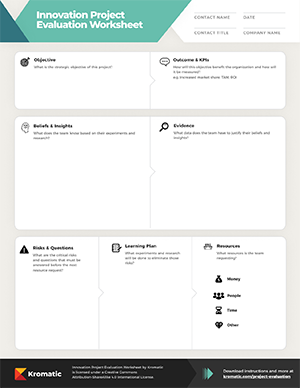
Try our Innovation Project Evaluation Template
Frequently Asked Questions
Why do corporate innovation projects fail even after getting funded?
The most common reason is that innovation boards allocate money but forget to assign dedicated people and set deadlines. Team members still have their day jobs at 100–150% capacity, so the innovation work gets pushed to nights and weekends—and eventually stalls. As product managers, we need to ensure investment decisions account for money, people, and time to be complete.
How do you calculate the true cost of an innovation team?
Add the personnel cost to the cash budget. If 3 team members spend 50% of their time for 3 months, that’s 4.5 person-months. At $20,000/month salary, that’s $90,000 in people costs alone. A $10,000 cash allocation actually becomes a $100,000 project—meaning the board only officially authorized 10% of the real investment.
Why is setting a deadline important for innovation projects?
Without a deadline, a small-budget project can quietly balloon in cost. A team given $10,000 and no time constraint might spend a full year on the work, inflating person costs from $90,000 to $360,000. Deadlines ensure the innovation board maintains visibility and control over the actual investment being made.
What happens when you don’t account for your team’s existing workload?
The innovation board may think they’re investing 50% of a team’s time, but if team members are already 150% booked, the real contribution might be only 5%. That means a planned $100,000 investment effectively shrinks to $19,000. We need to calculate opportunity costs and actively free up capacity so the intended investment actually materializes.
What should innovation boards allocate when funding a project?
Innovation boards must make complete decisions by allocating three things: money (cash budget), people (dedicated team members), and time (a clear deadline). Unlike venture capital, corporate money and headcount aren’t interchangeable due to how companies handle fixed costs. Ignoring any one of these three dimensions leads to incomplete decisions and underperforming innovation investments.

Comments
Loading comments…
Leave a comment