
What Is User Experience? It's Not Your Product or Wireframes
Your job is to take an unhappy user and make them happy. That's it.
 By Tristan Kromer ·
 Quick Answer: User experience isn’t your product, its features, or even your wireframes — it’s how people feel before, during, and after using what you’ve built. As product managers, our real job isn’t to ship a magic box of features; it’s to take an unhappy user and make them happy. UX is subjective and dynamic — it depends on who the user is, their context, and how their feelings change over time. A feature that delights one person might annoy another.
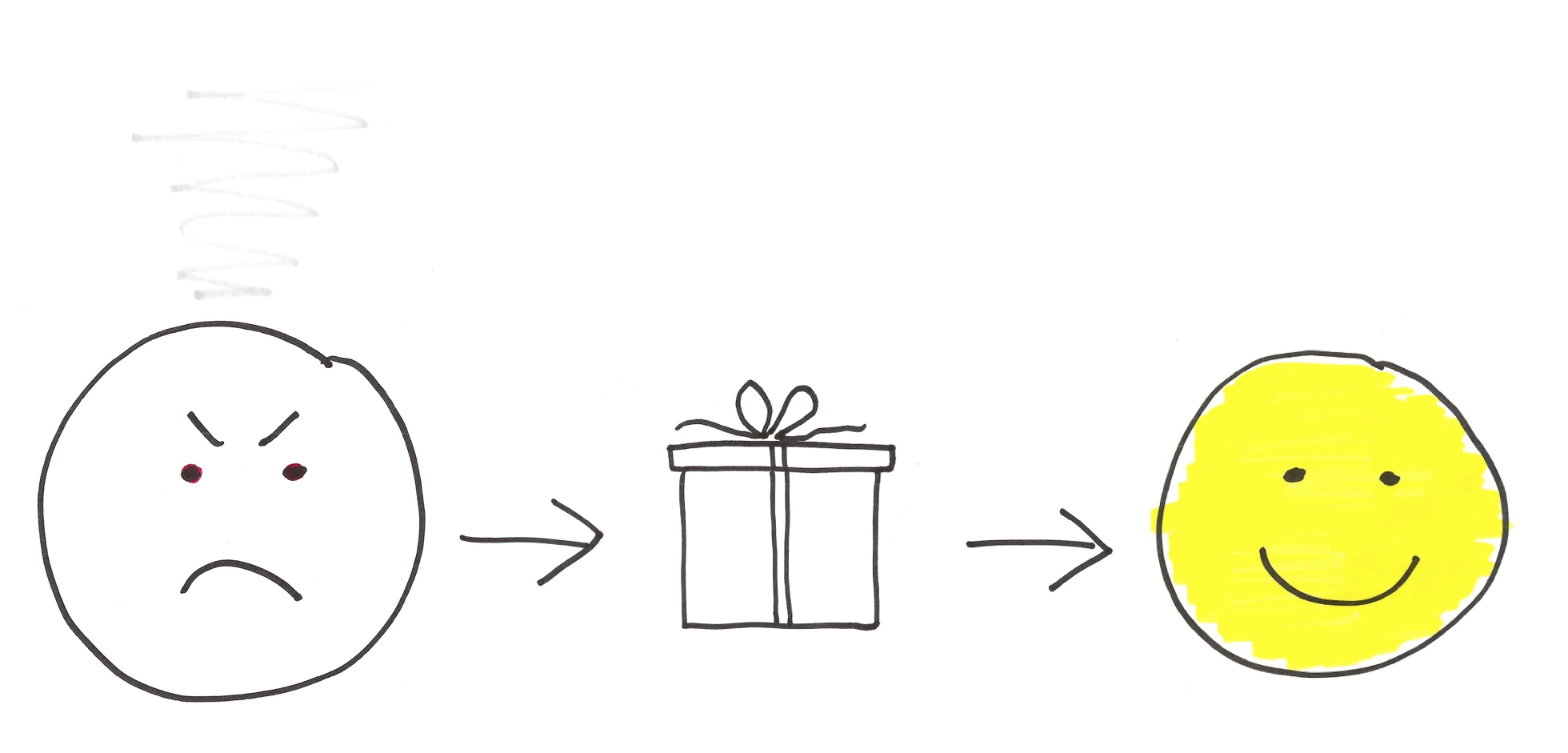
As a product guy who is constantly trying to dig deeper into user experience (UX) and user experience research, I’ve been asking myself how I define UX. So here we go: This is your product:  It’s a magic box with wondrous things inside. But that’s not user experience. That’s just a box with magic features, viral pixie dust, and a pretty marketing bow on top. Your job is not to make a product. This is your job:
 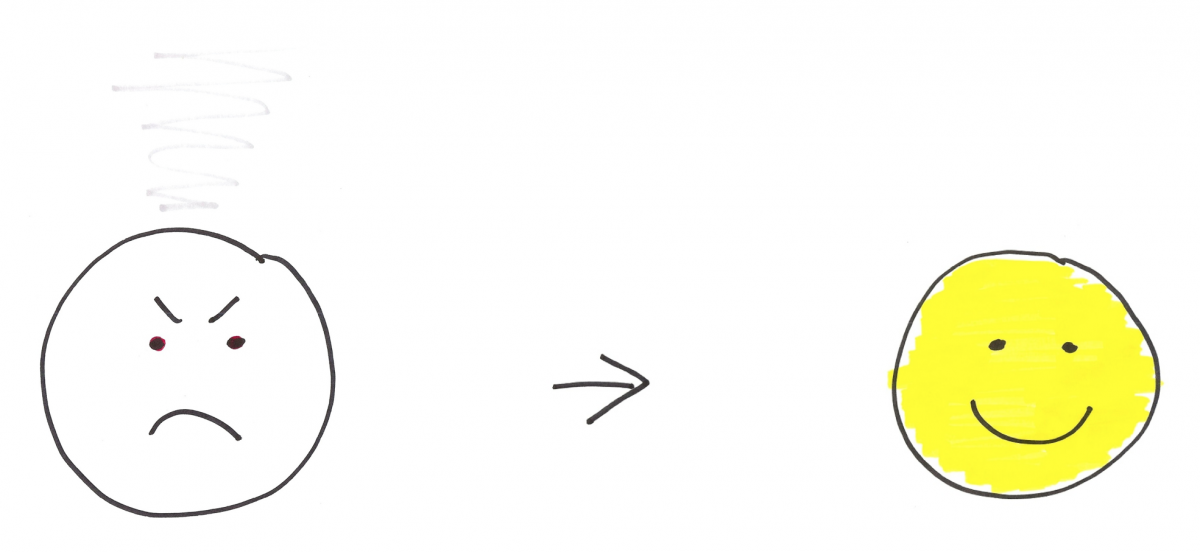 There’s an unhappy user out there somewhere in the real world. The user doesn’t care about your features or how you make their problems disappear, they care about being happy. (Ok…sometimes your job is not to make people happy…perhaps you’re designing a better water boarding device…but even so your job is still to make the user feel something.) So you hope that you can make the user happy with your magic box:
 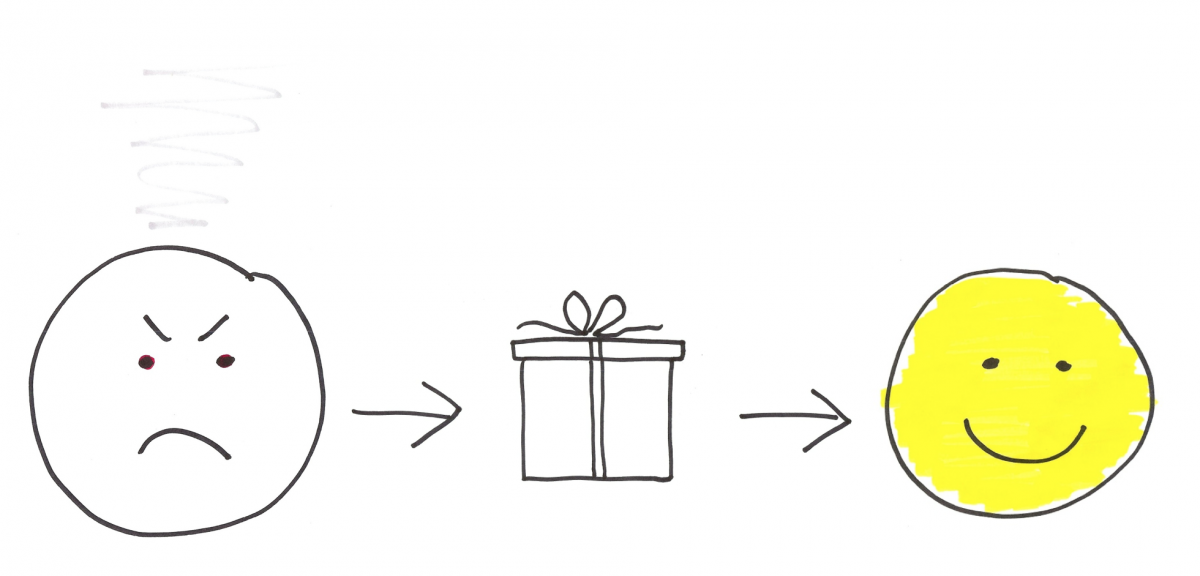 …but that’s not the UX either. That’s the beginning and the end…what’s going on in the middle? It’s not just your magic box product. Let’s zoom in. Since I’ve always heard that designers make wireframes…let’s make some wireframes. I’m going to redesign BBC News with a special new feature:
 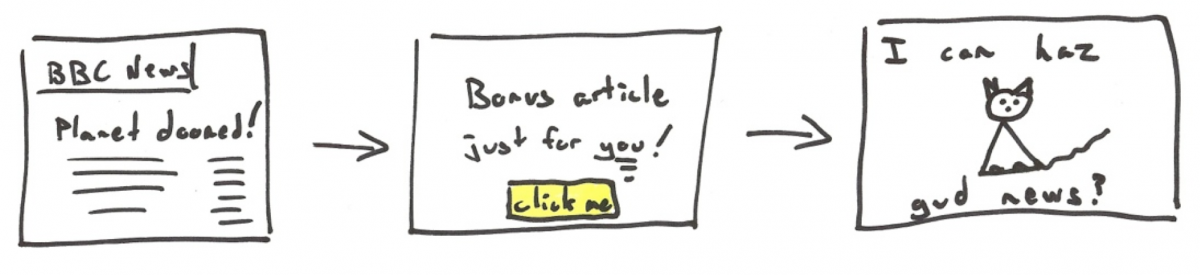 In this magic box, we’re adding a special lolcat bonus article to BBC news…because…well…why the hell not? Everyone likes lolcats! Is that the user experience? No. An artifact such as a wireframe, psd mockup, or specification that does not include the user can not possibly describe the UX. Where is the user in this wireframe? How does the user feel while going through this sequence of wireframes? This is the user experience if we’re lucky:
 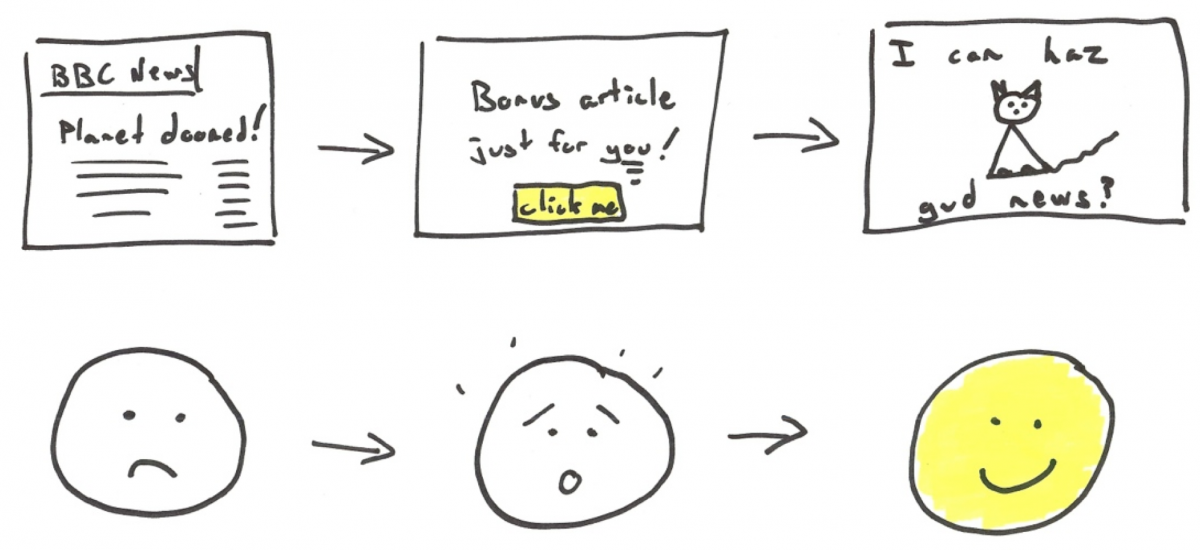 UX is not just a description of the product with wireframes, mockups, pretty pixels, or even running code. We hope the user has a good experience, but sometimes things turn out wrong:
 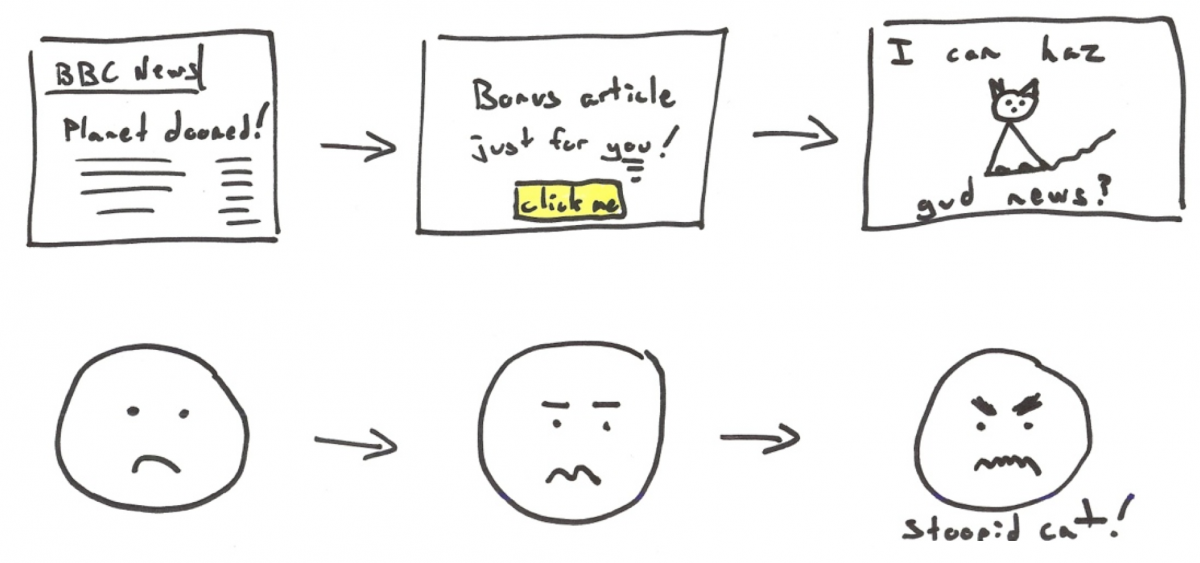 Maybe our typical BBC reader hates cats. Perhaps the user has just seen this feature so many times that they are no longer surprised by it and just find it annoying. It depends on who the user is, where they come from, how they get to the site, and their previous interactions with the site. But perhaps you wanted a more official definition. (Not entirely sure why you’re reading this blog if you want something official, but ok…I can cut and paste with the best of them.) Wikipedia defines it as:
User experience (UX) is the way a person feels about using a product, system or service. User experience highlights the experiential, affective, meaningful and valuable aspects of human-computer interaction and product ownership, but it also includes a person’s perceptions of the practical aspects such as utility, ease of use and efficiency of the system. User experience is subjective in nature, because it is about an individual’s feelings and thoughts about the system. UX is dynamic, because it changes over time as the circumstances change.
UX is not the product you are building. It’s how people feel before, after, and during their use of your product. It’s everything from anticipation to satisfaction.
Frequently Asked Questions
What is user experience (UX) in simple terms?
User experience is not the product itself — it’s how people feel before, during, and after using your product. As product managers, we need to remember that UX is subjective and dynamic, meaning it depends on who the user is, where they come from, and how their feelings change over time. It’s everything from anticipation to satisfaction.
Why aren’t wireframes and mockups the same as user experience?
Wireframes, mockups, and specifications are artifacts that describe the product, but they don’t include the user. If there’s no user in the picture, you can’t possibly describe the UX. We need to ask how the user feels while going through each screen, not just what the screens look like. The user’s emotional journey is what defines the experience.
Why do features alone not guarantee a good user experience?
A product packed with great features is just a “magic box” — it doesn’t automatically make users happy. The user doesn’t care about your features or how you solve their problems; they care about how they feel. A feature that delights one user might annoy another, depending on who they are, their context, and their previous interactions with your product.
How can user experience go wrong even with a good product?
UX can go wrong because it’s entirely dependent on the individual user and their context. Maybe your target audience hates the thing you thought was delightful, or maybe they’ve seen the same feature so many times it’s become annoying. As product people, we have to understand that UX is dynamic — it changes over time as circumstances change, so what works today might fail tomorrow.
What should a product manager’s real job be when it comes to UX?
Your job is not to build a product — it’s to take an unhappy user and make them happy. We need to focus on the user’s emotional state, not just shipping features. That means understanding who the user is, what they’re feeling, and designing the entire journey from anticipation through interaction to satisfaction, not just the product sitting in the middle.

Comments
Loading comments…
Leave a comment