
When Is Customer Discovery Process Done? A Practical Guide
Short answer: yes with an if. Long answer: no with a but.
 By Tristan Kromer ·
 Quick Answer: As product managers, we’re ready to move past customer discovery when additional interviews show diminishing returns — our customer persona has stabilized across rounds, and we have a concrete hypothesis about customer pains and value proposition ready to test for purchase intent. A practical benchmark: interview 5–20 customers per cohort over one-week sprints, running multiple rounds until outliers shrink and patterns emerge. But customer discovery never truly ends — the best companies interview customers continuously to keep pace with changing markets.
We’ve planned and executed our customer discovery process like George Clooney pulling off a casino heist. We’ve perfected every detail through three rounds of interviews. Now we have a dozen interesting people telling us a dozen interesting stories that have given us the insights we were looking for. We’re feeling pretty good about ourselves. We’re going to celebrate at Cracker Barrel. But a question keeps nagging at us. Are we actually done with the customer discovery process? Short answer, yes with an if. Long answer, no with a but.
The Customer Discovery Process
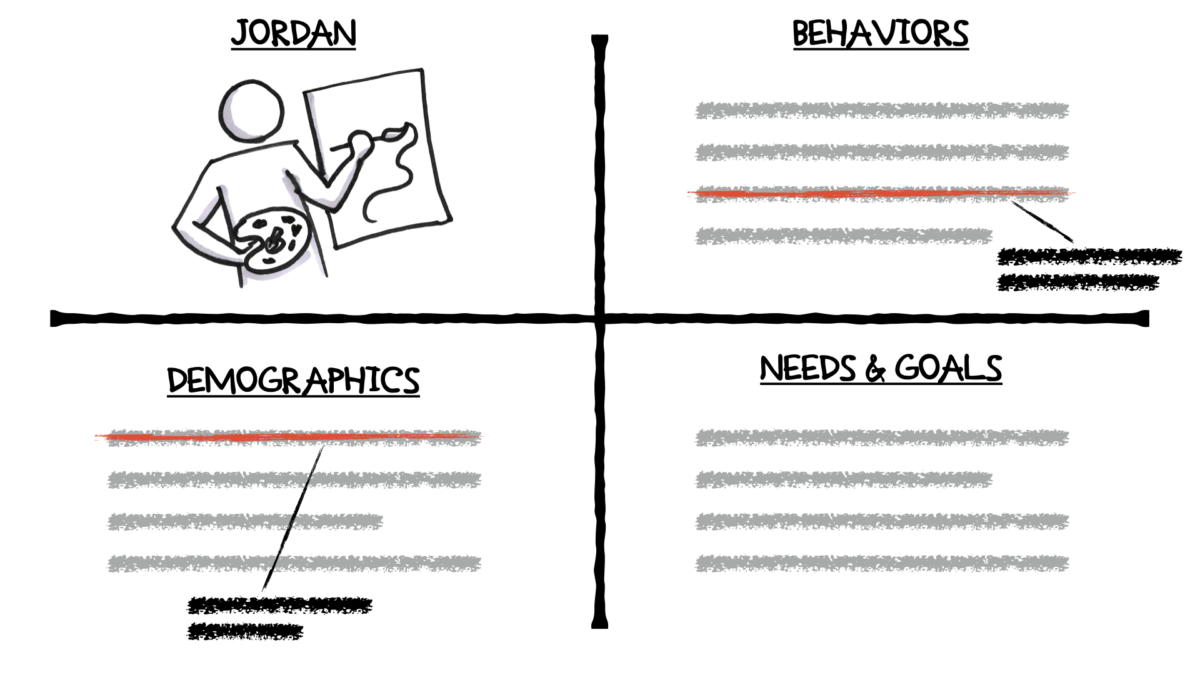
Customer discovery is a scientific method that provides evidence to support product-market fit. We collect data about our customers’ challenges, and then synthesize that data to zero in on our target persona. There are a wide range of 4-step guides out there to walk entrepreneurs and lean startups through the phases of their customer discovery programs. But simply put, we are done with customer discovery if we have a concrete hypothesis. That hypothesis should be about the customer pains and desired value proposition that we are then ready to test for purchase intent. That is to say, additional interviews are showing diminishing returns. We are no longer learning at the same pace. We have a decent sample size to synthesize the data, and that data synthesis gives us the focused customer persona we need. Time to move on to an actionable agenda. Goodbye stranger, it’s been nice. 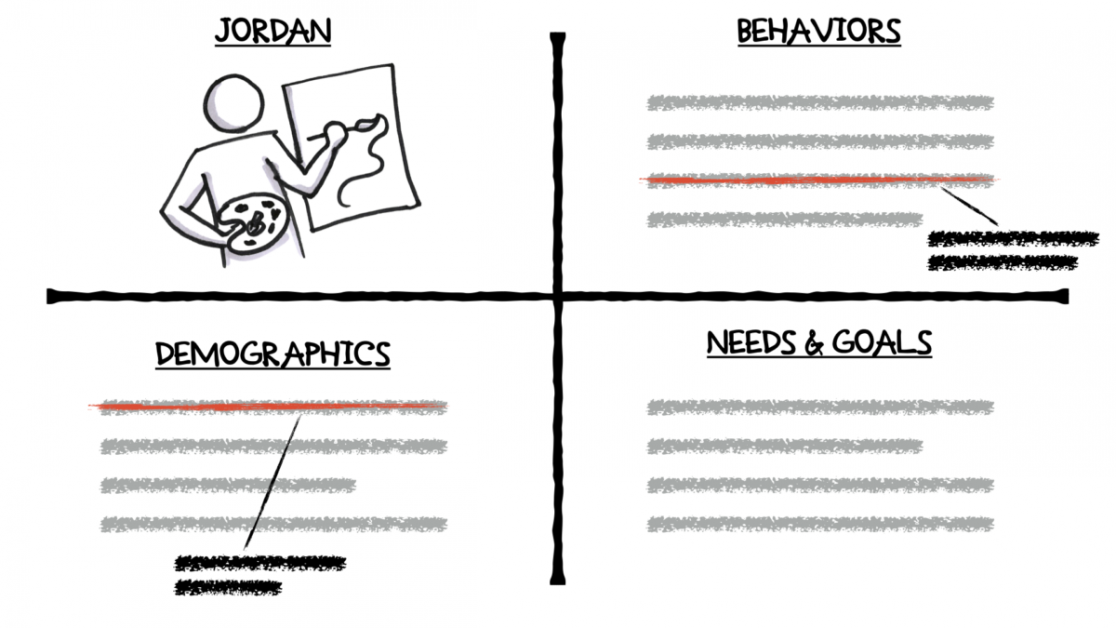 At the same time, we’re NOT done with customer discovery, because we are never done. Potential customers will be continuously discovering our product. So we need to continuously discover how our customers are changing, as well as explore new segments and opportunities. But we can’t steer our boat if we never leave the dock. (Unless the boat is towing the dock for some reason, but let’s save that discussion for another time.) At some point we need to build a product and see if anyone will buy it. Or rather, we need to see if anyone will buy it and then build the product. So we can’t just talk to people forever. What we really need here is a more practical question: What are the elements of a complete customer discovery process?
How Many Customers Should We Interview?
This is simply a question of too few versus too many. If our initial customer persona is “independent store owners,” but we interview just three or four retailers, then we are getting a limited view. If even one of these people is an outlier, then our conclusions are going to be skewed away from early adopters. We may interview a Bob’s Porcupine Emporium and the next thing we know we’re trying to sell water balloons to porcupines.  On the other hand, if we are interviewing 50 people a week, we are going to get lost in the data. We are not Google. We don’t have the resources to blow on an experiment to determine which of these 41 shades of blue will earn us an extra $200 million. Time is precious, so let’s focus on quality instead of quantity.
How Long Should My Interview Sprints be?
It’s also important to conduct these interviews (and perform our synthesis) over a relatively short period. If we interview 10 store owners in 10 weeks before we debrief, it will be hard to remember the context of the early interviews. We’re more likely to unnecessarily fixate on the last thing we heard. This is a classic example of recall bias. We need a small batch of data for our small human brains to deal with. Every company is different, every product is different, and every customer discovery canvas is different. But a practical rule of thumb would be to interview 5-20 potential customers in a single cohort over a one-week period. Ideally, each team (one interviewer and one note taker) should be involved in at least five interviews. So a team of four people should run at least ten interviews in a week. In Lean Startup, this is the Build, Measure, Learn loop backwards. We are trying to Learn who our customer is and what their pain points are. Then we figure out the customer discovery metrics we need to Measure. In this case, it’s qualitative data from interviews that will help us figure out our ideal customer persona. Then we Build our interview guide. At this point, we can go through the loop forward: conduct the research, evaluate the data, and hopefully learn something useful. 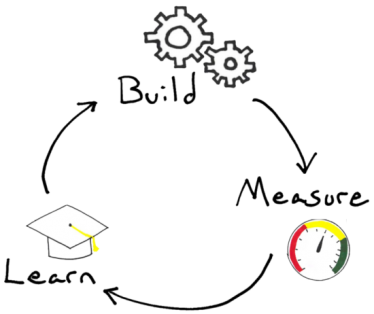
How Many Rounds of Interviews Should We Do?
Again: too few or too many? The purpose of conducting multiple rounds of interviews is to refine our generative research (Who is our customer?). We do this to maximize the value of our evaluative research (How much will they pay for our product)? If we correctly process the information we get from store owners, we will notice our customer persona no longer radically changes week to week. As Steve Blank tells us, we want lots of data, but only so we can extract insights from our customer discovery activities. With each round of interviews, we should see a reduction in outliers and an increase in actionable insight. This will get us closer to our MVP. It helps to start with an open-ended script in the early rounds, noting the questions that provoke useful responses. These responses will help us better understand our customer. We can then use these points to refine our customer persona and add new, more tightly focused questions with each round. Keep in mind that other experiments — such as surveys and ethnographic observation — will augment our discovery data. But once we’ve refined our customer persona enough to shed our preconceived biases, we are ready for solution testing, and finally an actual build. Hooray! 
How Do We Process The Information?
What are we actually looking for in our data? What will allow us to move from one round to the next, and ultimately to a product launch? We want to see actionable insights, such as patterns and themes. If we cross-reference our interviews to update our assumptions and tighten our customer persona, then we are on our way. We can build a business by clearly understanding who our customers are and what we will need to build to make them happy. (Practical tip: Download our free customer discovery note-taking template to document your interviews, and our customer persona framework to document your target early customer. This material will simplify customer discovery training for your team.) To be clear, we are not looking for a certain percentage of customers to agree with us or hand us money. We are looking for a customer segment that our product can effectively target and build a business model on. So instead of searching for a group of interviewees to validate our preconceived biases, we need to look for a pattern. We should look for something that members of our desired customer segment have in common. If only 3 out of 20 store owners are interested in our product, that’s ok. But the fact that those 3 people own single stores while the other 17 own chains reveals a pattern. This tells us what to look for as we set up our next round of interviews.
When Does the Customer Discovery Process End?
Never.  The industry is constantly changing. The market is constantly changing. People are constantly changing. Some of the best companies out there do discovery interviews every week. The customer discovery process is not only a path to building a product. It’s a circuit course that helps us exercise and grow a viable business model. It’s routed in questioning our assumptions, something we can only do by talking to our target customers. So if we want to be disruptors, we need to have conversations with our customers, and get comfortable talking to strangers.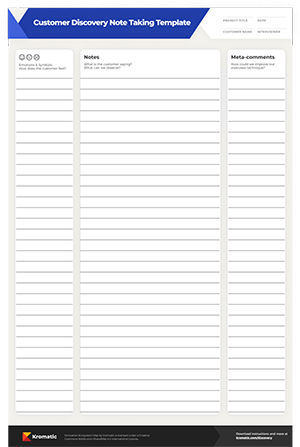
Download our Customer Discovery Notetaking Template
Frequently Asked Questions
How do I know when the customer discovery process is complete?
We’re ready to move on when additional interviews show diminishing returns — meaning we’re no longer learning at the same pace, our customer persona has stabilized across rounds, and we have a concrete hypothesis about customer pains and desired value proposition that we’re ready to test for purchase intent. That said, customer discovery never truly ends; we should continuously revisit it as markets and customers evolve.
How many customer interviews should I do during customer discovery?
A practical rule of thumb is to interview 5–20 potential customers per cohort over a one-week period. Each team (one interviewer, one note taker) should participate in at least five interviews, so a four-person team should aim for at least ten interviews in a week. Too few interviews risk skewed conclusions from outliers, while too many create data overload without proportional insight.
How many rounds of customer discovery interviews do I need?
We should run multiple rounds, refining our interview script and customer persona each time. With each round, we should see fewer outliers and more actionable insights. Once our customer persona no longer radically changes week to week and we’ve shed our preconceived biases, we’re ready to move on to solution testing and building an MVP.
What should I look for when analyzing customer discovery interview data?
We’re looking for patterns and themes across interviews — not a certain percentage of people agreeing with us. By cross-referencing interviews, we can update assumptions and tighten our customer persona. For example, if only 3 out of 20 store owners are interested but all 3 share a common trait (like owning single stores versus chains), that pattern tells us exactly who to target next.
Why should customer discovery interviews be done in short sprints?
Conducting interviews over a short period (roughly one week per cohort) prevents recall bias. If we spread ten interviews across ten weeks before debriefing, we’ll struggle to remember early conversations and fixate on the most recent ones. Short sprints give our brains a small, manageable batch of data to synthesize effectively and move quickly through the Build, Measure, Learn loop.

Comments
Loading comments…
Leave a comment