
Innovation KPIs by Department: How to Measure What Matters
If it's not in the OKRs, it's not happening.
 By Tristan Kromer · · 8 min read
 Quick Answer: If innovation isn’t explicitly included in department-level objectives and OKRs, don’t expect it to happen — it becomes an empty slogan. As product managers, we should choose innovation KPIs based on the biggest obstacle to innovation in each department (fear, bureaucracy, lack of strategy), then pick actionable metrics that measure progress against that specific barrier. Avoid vanity metrics like raw idea counts; instead measure things like ideas per employee and what happens to those ideas. Reward intrapreneurs with autonomy and time, not just formulaic cash bonuses that incentivize gaming the system.
Department-level innovation is a necessary part of a healthy innovation ecosystem. Here’s how to foster it, measure it, and reward it by focusing on your innovation KPIs. Innovation Management isn’t just the fun stuff like coaching teams and setting up investor boards. It requires developing an entire innovation ecosystem, and then setting up innovation metrics to measure the output of that ecosystem. At some point, we have to measure impact and set the right innovation KPIs for the HR department. I get questions on this topic regularly, so I’m going to paraphrase a few of them and break them down for you.
Department-level innovation
Within internal innovation programs, what’s your view in applying innovation objectives by department, giving them the same relevance as the traditional objectives teams are evaluated for?
If innovation is a priority, it should absolutely be included in company, department, and personal objectives. If it’s not in the objectives, we shouldn’t be surprised if nothing happens. I once worked with a company that had “growth” as its company-wide priority. It was mentioned in every big meeting, and every single person in the company knew that was the priority. But there were no innovation KPIs. The only team that had growth as part of its own objective was the growth team. The growth team only had one person.  They didn’t even have an engineer to actually implement the growth experiments the growth hacker came up with. So it wasn’t a big surprise when growth never really happened. When your growth team is a team of 1, instead of growth you will get loneliness, which is a common innovation obstacle. It can be overcome with a network of innovators who can exchange knowledge and support each other, a critical element to any innovation ecosystem. Long story short, if business growth is a priority for the company, it should be a priority for everybody in the company. This makes it an innovation catalyst instead of an innovation obstacle.
Managing innovation metrics
What types of objectives or metrics should be used to measure department-level innovation?
Your innovation KPIs depend entirely on the objectives of the company and program, which should be based on the strategy of the company. Department-level innovation should mirror company-level innovation and should be measured the same way. Assuming the objective of the innovation program is to increase the general ability of the company to innovate, we’d call that innovation ecosystem design. So we want to create an environment where intrapreneurs can systematically create new business models over and over again. That’s a very big project. So instead of trying to tackle everything at once, each department should target a proximate objective based on their biggest obstacle to innovation. What’s stopping intrapreneurs today? What is stopping innovation at your company or in your department? Is it fear? Bureaucracy? Lack of innovation strategy? Pick the one thing you think is most important and focus the objective on removing that obstacle. 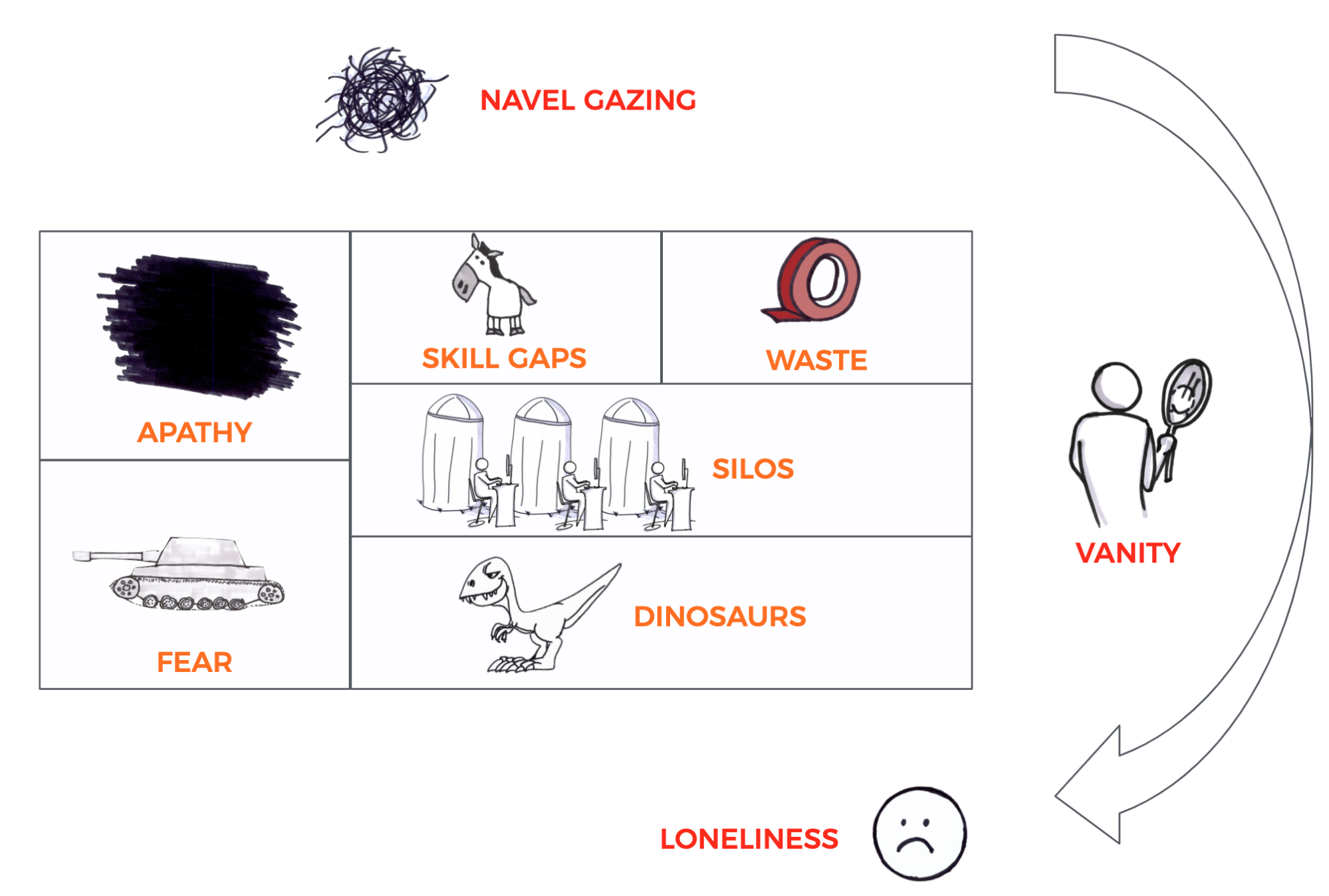 Any metrics chosen should be based on that obstacle. You will likely find that the main obstacles to innovation at the department level are the same obstacles faced at the company level, which is not surprising since the individual departments feed off the company-wide innovation ecosystem. So let’s say your main obstacle is one of the most common ones: Intrapreneurs aren’t submitting enough ideas because they are afraid of criticising the status quo. Some quick and dirty ways of measuring that obstacle might include:
- Quantifying the number of ideas being submitted and what happens to those ideas
- Getting qualitative feedback on how people perceive the culture of the company
- Looking at HR records to see if people who criticize the company are promoted or fired
Of course you need to make sure you are fully analyzing the data, not just looking at vanity metrics. For example, just measuring the number of ideas submitted only gives you a partial view of the problem. That is not an innovation KPI. If one company, Spacely’s Sprockets, has 200 ideas submitted and another company, Cogsley’s Cogs, has 1,000 ideas, who is doing better at innovating?  At first glance, it’s Cogsley. But if Spacely has 100 employees and Cogsley has 200,000, then Spacely clearly has better employee engagement around innovation. The raw number of ideas is important, of course, but the % of ideas per employee tells us much more about whether or not the company is using 100% of its brainpower to innovate. The raw number makes us feel good about ourselves — 200 is a lot of ideas! — but it doesn’t give us the information we need. Don’t measure innovation with vanity metrics, use real innovation KPIs!
Innovation management
If we have “innovation ambassadors” within departments to foster innovation and help implement projects, should we also have objectives for them? What about rewards?
As above, absolutely. If we are not explicitly setting a strategy and objectives, then we shouldn’t expect results. Keeping track of Objectives and Key Results (OKRs) is one way to make this explicit in your company. And rewards? This is a bit tricky. I am absolutely in favour of rewarding people for effort and results. However, “rewards” are often taken to a formulaic extreme by HR departments, which just results in clever people gaming the system by setting low bars to receive 100% of the bonus pool. We can’t just give a cash prize for “most number of ideas submitted.” We’ll wind up with ideas for broccoli-flavored ice cream and Twitter, but with only 139 characters.  Contrary to popular opinion, corporations are not just filled with people maximizing profit. Most of the intrapreneurs I know leap at the chance to do a project they find meaningful. For one client, I conducted a series of interviews with intrapreneurs to establish the biggest obstacle to innovation. They almost invariably had the same answer: “Time.”
  They were working weeknights and weekends to make their idea work, but of course their time is limited. If the project was to get funding, they needed time to actually flesh it out. They were motivated and ready to go. They found their own purpose. They just needed the autonomy to do it. There’s nothing inherently wrong with monetary rewards, but imagining that most people are automatons motivated entirely by money is a myth. (Dan Pink’s video on Drive is a great overview on what motivates people.)
  True innovation is probably not going to fit into the current innovation KPIs. So it’s nice to have a human being who can look at what everyone is doing and override the formula to reward a true entrepreneur who delivers impact outside of the reward system with a combination of applause, a fat paycheck, and the opportunity to write their own job description.
Lessons Learned
- Choose metrics for an innovation program based on obstacles to innovation.
- Choose actionable metrics or you’ll get what you measure.
- Make rewards line up with motivation. Rewards can be social, personal, or monetary.

Download the Innovation Ecosystem Booklet
Frequently Asked Questions
What are innovation KPIs and why do they matter at the department level?
Innovation KPIs are specific, actionable metrics tied to your company’s innovation objectives — not vanity metrics like raw idea counts. They matter at the department level because if innovation isn’t explicitly included in department objectives, nothing happens. Department-level innovation KPIs should mirror company-level goals and focus on removing the biggest obstacle to innovation in that department.
How do you choose the right metrics for an innovation program?
We should choose innovation metrics based on our biggest obstacle to innovation, not generic benchmarks. First, identify what’s stopping intrapreneurs — whether it’s fear, bureaucracy, or lack of strategy. Then pick actionable metrics that measure progress against that specific obstacle. For example, if fear is the barrier, measure ideas per employee rather than just total ideas submitted, and examine what happens to those ideas afterward.
Why is counting the number of ideas submitted a vanity metric?
Raw idea counts don’t tell us enough on their own. A company with 1,000 ideas from 200,000 employees has far worse engagement than a company with 200 ideas from 100 employees. The percentage of ideas per employee reveals whether we’re tapping into our full brainpower. Without that context, a high number just makes us feel good without providing actionable insight — that’s a vanity metric, not an innovation KPI.
How should companies reward innovation ambassadors and intrapreneurs?
We need to be careful with rewards. Formulaic cash prizes for metrics like “most ideas submitted” lead to gaming the system with low-quality ideas. Most intrapreneurs are motivated by purpose and autonomy — many just need dedicated time to work on their projects. Effective rewards combine social recognition, meaningful compensation, and the opportunity for greater autonomy, aligned with what truly motivates people rather than assuming everyone is driven solely by money.
What happens when innovation is a company priority but not in team objectives?
Nothing happens — or at least nothing meaningful. As product managers, we’ve seen companies declare growth a top priority in every meeting while only assigning it to a single-person team with no engineering support. When innovation goals aren’t embedded in every department’s objectives, they become empty slogans. Making innovation explicit in team OKRs turns it from an obstacle into a catalyst across the organization.

Comments
Loading comments…
Leave a comment