

Value Creation Looks the Same With or Without Technology
If your product only works on a screen, you're stealing attention.
 By Tristan Kromer ·
 My good friend and longtime Lean Startup Circle organizer and volunteer Spike Morelli (who has great office hours) gave me a wonderful book and card for my birthday. In addition to a really nice note, he asked a question on the card related to value creation: 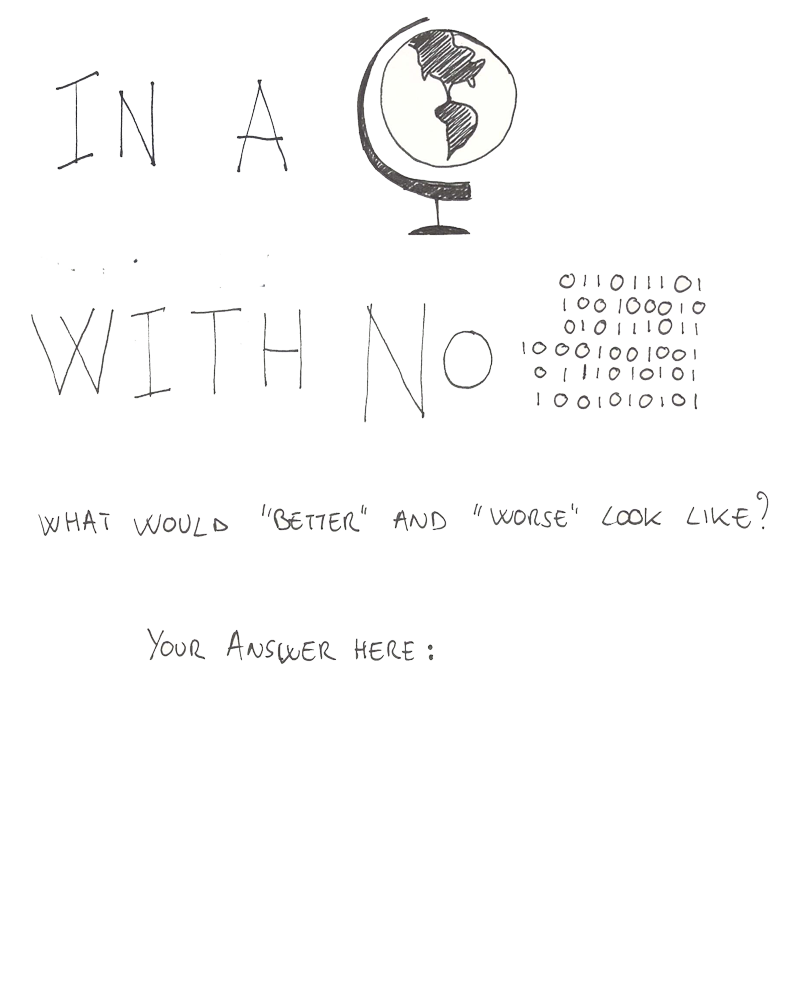 It’s a simple question, once I decided that Spike isn’t actually geeky enough to make me translate the binary into a number into order to interpret it. I read it as:
In a world with no technology, what would “better” and “worse” look like?
Of course, I realized after a bit that he could have also meant “data” instead of “technology” but that doesn’t change my answer at all.
Same Ol’ Same Ol’
My answer is simple. The same. Better and worse would look identical with no technology. Here is better: That’s me and the love of my life (who also drew this) having a wonderful time being together. This is worse: 
Technology is not a Goal
 If we, as product managers or even just as human beings, take technology as its own end we wind up with things like the Vessyl, whose ridiculousness is best pointed out by Stephen Colbert. Most of the great technology products that we use day to day don’t create brand new behaviors or experiences, they just enhance them. They make them simpler. We wrote SMSes before Twitter and postcards before that. We checked out our classmates on a real paper facebook before Facebook. We read newspapers and played 99 Bottles of Beer on the Wall to entertain ourselves on trains before Clash of Clans. If the goal of our product is to make people push a button over and over, it’s just cruft.
Quick Answer: True value creation looks the same with or without technology — it centers on enhancing real human experiences like connection, relationships, and quality of life. As product managers, we must remember that great products don’t invent new behaviors; they simplify existing ones (SMS before Twitter, paper facebooks before Facebook). When technology or data becomes an end in itself, we end up building absurd products nobody needs — stealing attention rather than creating genuine value.
Life without Data
 Without data, what would better and worse look like (value creation)? Again…the same. Life is quality, not quantity. However much we might measure time on page and bounce rate, the data is a proxy for the quality of enjoyment. The data by itself is nothing. Quantitative data does not trump qualitative and the false competition is silly. We need to love, fight, scream, and yelp. We need to experience. Just because we’ve tricked someone into click buy now doesn’t mean our product is awesome. There have always been con artists and digital con artists are no better. We have to build, not to build, but to build for something. To build for someone. Otherwise we’re not creating value. We’re just stealing attention.
Lessons Learned
Frequently Asked Questions
What does value creation look like when you strip away technology?
According to this perspective, better and worse look exactly the same with or without technology. True value creation centers on human experiences — relationships, connection, and quality of life. Great technology products don’t invent new behaviors; they enhance existing ones, making them simpler. If we lose sight of that, we end up building products nobody actually needs.
Why shouldn’t product managers treat technology as a goal in itself?
When technology becomes an end in itself, we get absurd products like the Vessyl smart cup. As product managers, we need to remember that most successful tech products — Twitter, Facebook, mobile games — simply enhanced behaviors people were already doing. SMS existed before Twitter, paper facebooks before Facebook. The goal should be enhancing human experiences, not just making people push buttons.
Does quantitative data matter more than qualitative data for measuring product success?
No — quantitative data does not trump qualitative data. Metrics like time on page and bounce rate are only proxies for the quality of someone’s experience. The data by itself is nothing. As product managers, we need both, but we should never mistake tricking someone into clicking “buy now” as proof that our product delivers real value.
What’s the difference between creating value and stealing attention?
True value creation means building for something and for someone — enhancing real human experiences and solving genuine problems. Stealing attention, on the other hand, is the digital equivalent of a con artist. Just because we’ve optimized a funnel or increased engagement metrics doesn’t mean we’re delivering something meaningful. We have to build with purpose, or we’re just adding cruft.
How do great technology products actually create value?
Great technology products succeed by making existing human behaviors simpler and more accessible, not by inventing entirely new ones. People were already sharing short messages, looking up classmates, and entertaining themselves on commutes — Twitter, Facebook, and mobile games just enhanced those experiences. Value creation comes from understanding what people already need and removing friction.

Comments
Loading comments…
Leave a comment