
Customer Discovery Questions: A Crash Course in Asking Better
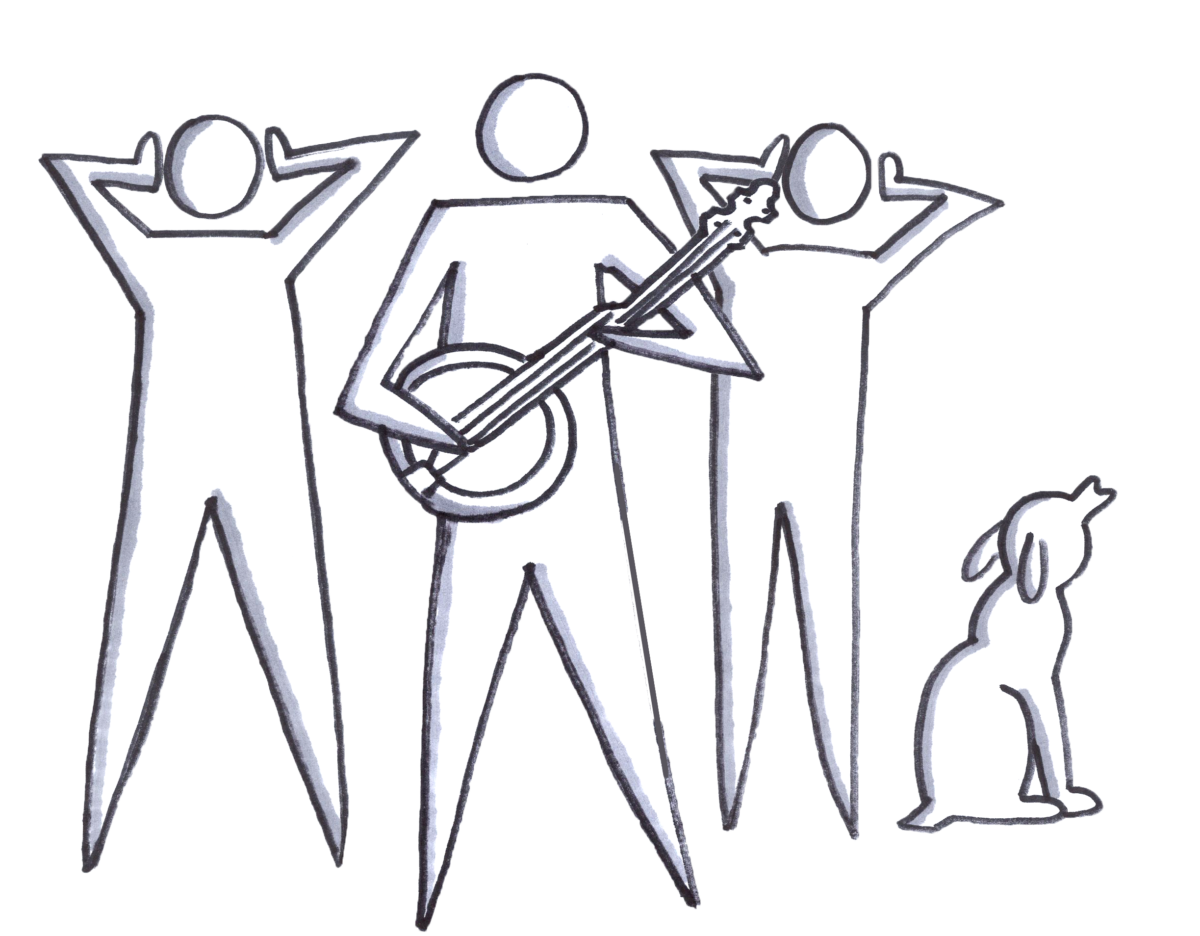
Because your banjo-playing friend won't tell you the truth on his own.
 By Tristan Kromer ·
 Quick Answer: The key to effective customer discovery questions is prioritizing open-ended prompts (“Tell me about…” “Describe…”) over closed yes/no questions, which tend to reinforce our biases. As product managers, we should follow the 80/20 rule—customers talk 80%, we talk 20%—using closed and probing questions only to steer, while open questions reveal the stories and unexpected insights that matter most. Done right, this approach can even reveal we’re targeting the wrong persona entirely.
Customer Discovery questions by: Tristan Kromer “Question everything, even the question mark.” - Dick Allen, Zen Master Poems A customer discovery interview is a sea voyage for which there is no map. At any moment, we may crash into an awkward pause, be devoured by a bias lurking just beneath the surface, or sail in the wrong direction entirely, thinking it’s the right one, and wash ashore on the Island of Wasted Time.  But just because we don’t have a map doesn’t mean we don’t have any tools. The types of questions we ask (and how we ask them) are the compass of the interview process, guiding the trip in directions most useful to our topic of inquiry (or at the very least preventing us from going in circles).
THE BANJO’S CURSE
Let’s say a friend of ours plays the banjo. Weird, right? Everyone knows banjo players don’t have friends. And that’s the problem — he’s driven away most of his friends already with his tone-deaf, cacophonous plucking. If he plays at the folk festival this weekend, we may lose him forever. (Yes, I speak from experience. I do play the banjo poorly and it is very loud.)  But what if we could find a way banjo players can keep playing without driving people away? Is there a market for a product that would silence a banjo for everyone but the player? So we invent an earpiece for the musician that will allow only them to hear the banjo, sparing their friends and family the pain and suffering only banjos, accordions, and bagpipes can bring. Our customer persona is obvious: friendless, mediocre banjo players. Now let’s steady our compass and navigate the questions.
QUESTION TYPES
Closed
Yes/No A simple yes/no question. Q: Do you play the banjo?  Useful only when needed to verify a particular point, such as establishing who we are talking to so we’re sure we’re interviewing the right persona. A: Yes I do. Forced Choice A question with limited potential answers. Similar to a yes/no question, but potentially offering more options. Q: How many times a day do your neighbors complain about your banjo playing? Useful only when needed to verify a particular point or add a little detail. Note that a question like this would be based on information they already gave you — if you have not already established that the neighbors complain, then it would be a leading question built on your own assumption. A: Every chance they get, both verbally and with thrown objects. Probing While lacking the characteristic of limited options provided by other closed questions, probing questions narrow the field of inquiry by focusing on a particular direction: Who, What, When, Where, Why, How. Q: Who told you that learning the banjo would be good for your social life? Again, this would be a leading question if it had not already been established that someone told them this specific thing. That’s why this is a “probing” question — it examines established territory in more detail. Probing questions are useful for taking the conversation in the direction you want it to go. They generally appear in the early stages of an interview when we’re trying to focus the conversation, and intermittently to steer the conversation in a specific direction. A: The creepy old man at the gas station who gave me suspicious directions.
Repeated
Re-asked Simply repeating an earlier question. Q: You said you play the banjo? Only asked if we’re not certain we understood the original answer. Usually we suggest repeating what we heard the customer say and asking if that’s correct. A: Yes I do. Clarification A question that confirms a previous statement by simply repeating the statement in the form of a question. A broader definition might include requesting more detail to ensure we understand the answer fully. Q: So your neighbors complain often? Again, we have to be careful of leading questions. This question would only be asked if the customer had already mentioned this fact. A: It’s like they never stop.
Open
Open-ended Frames the boundaries of the topic without suggesting the answer go in any particular direction. Open-ended questions are actually not questions at all, but statements, usually starting with command words like describe, tell, and explain. Q: Tell me about the moment you decided you’d rather play the banjo than have friends. These are our meat-and-potatoes questions, the ones that get the customer talking and let us be quiet for a while. Once we discover the more promising directions the interview can take, we ask open-ended questions as an invitation for the customer to explore the topic freely. A: It wasn’t really my decision. My friends tried to warn me, but I didn’t listen. I thought I’d be Bela Fleck, but I can’t even get it in tune. My friends didn’t know how to cope with the noise or how to talk me out of it, so it wasn’t long before they just gave up and stopped calling. Leading Suggests a potential answer or direction to take the conversation. Q: Do your neighbors complain because they don’t like banjos in general or because you’re not very good at playing it? Generally avoid these questions — founders often fall into the trap of unintentionally asking leading questions that put their assumptions onto the customer. A: Jerk, my playing is magnificent to those with a sense of refinement! Multiple Asking several closed and/or open questions in succession. Q: When did you start playing banjo? Did your spouse support your decision? Was it a factor in your divorce? Useful to offer a narrative frame for our customer and get them to tell us a story. This is essentially a pushy form of an open-ended question (Tell me about…Describe for me….) — it carries the risk of making our interview sound like an interrogation. A: What is this, an interrogation?
TALK LESS, HEAR MORE
Closed and repeated questions have their purpose, but should be used sparingly. They are a means to guide the conversation, but the useful information we’re searching for will usually be revealed in the stories we get out of open questions. Correctly programming our questions will also address an important informal rule about interviews: talk as little as possible. The more we talk, the more the customer falls into listening mode and out of sharing mode. We need to always remember the 80/20 rule — the customer speaking 80% of the time and the interviewer speaking no more than 20%, a goal easily achieved if we prioritize open questions and let the customer talk.  Asking the wrong types of customer discovery questions can unintentionally influence the answers. Humans are psychologically geared to please others in a conversation, particularly when it is with someone we don’t know (making a good first impression and all that). A single, forced-choice question followed by a series of yes/no questions that confirm our preconceived biases can derail the entire interview, and worse, lead to false conclusions about our customer that takes our discovery in the wrong direction. Understanding how customer discovery questions work can do more than help the interview — it can help the interviewer. Not only will it allow us to better navigate the conversation, it will make us more confident in our approach, and even help us — heaven forbid — enjoy talking to a stranger. In the case of our increasingly friendless banjo-playing friend, the closed questions steered us in a useful direction (the relationships between banjo players and their friends), and our crafty open questions revealed the window of opportunity (when the friends are worried about the new banjo habit, but don’t know what to do about it). This gives us our key discoveries, a pattern that showed up in 60% of our interview subjects:
- Banjo players are completely oblivious to the pain they bring others.
- People don’t know what to do with a banjo-playing friend, and tend to cut their losses early.
Now we know that the banjo player isn’t the customer persona we need for our product — they don’t think there’s a problem. Their friends, however, might be desperate for a solution. Our next step should be to validate our new assumptions: let’s go talk to the friends! Once the revised customer persona has been validated with a new line of interviews, then we revamp our marketing strategy — focusing on people buying our product to give to their banjo-playing friends, instead of marketing to banjo players directly — and boom: we are all getting rich on our bestselling invention to stifle the banjo: The Banjon’t. 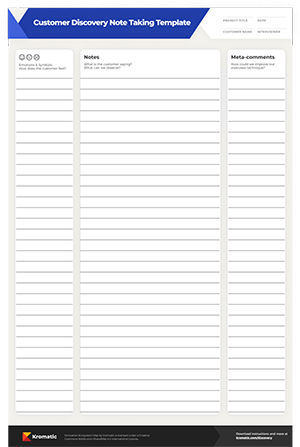
Download our Customer Discovery Notetaking Template
Lessons Learned
- Asking our customer closed-ended questions can reinforce our biases and derail the customer discovery process.
- Open-ended questions prompt our customers to tell their stories and help us to do the most useful thing an interviewer can do: Shut up.
- When you play a banjo poorly, you hurt everyone that banjo has ever played for. It’s not your fault. Please seek help.
Frequently Asked Questions
What are the main types of customer discovery questions?
Customer discovery questions fall into three broad categories: closed questions (yes/no, forced choice, and probing), repeated questions (re-asked and clarification), and open questions (open-ended, leading, and multiple). As product managers, we should prioritize open-ended questions — they prompt customers to share stories and reveal insights — while using closed and repeated questions sparingly to steer the conversation.
Why are open-ended questions so important in customer discovery interviews?
Open-ended questions are our meat-and-potatoes questions because they get the customer talking and let us listen. They’re actually statements — starting with words like “describe,” “tell,” or “explain” — that invite customers to explore a topic freely. This supports the 80/20 rule: the customer should be speaking 80% of the time, which is where the most useful discoveries happen.
How do leading questions hurt customer discovery?
Leading questions suggest a potential answer or direction, which unintentionally puts our own assumptions onto the customer. Since humans are psychologically geared to please others in conversation — especially strangers — leading questions can confirm our preconceived biases and lead to false conclusions. As product managers, we need to watch for these carefully, because founders often ask them without realizing it.
How can customer discovery questions reveal you’re targeting the wrong persona?
By combining closed questions to steer the conversation with open questions that let customers tell their stories, we can uncover patterns we didn’t expect. In the article’s example, interviews revealed that banjo players didn’t think they had a problem — but their friends were desperate for a solution. The right customer discovery questions helped pivot the target persona entirely, which reshaped the product’s marketing strategy.
What is the 80/20 rule in customer discovery interviews?
The 80/20 rule means the customer should be speaking 80% of the time while the interviewer speaks no more than 20%. We achieve this by prioritizing open-ended questions and resisting the urge to fill silences. The more we talk, the more the customer falls into listening mode and out of sharing mode, which defeats the purpose of the interview.

Comments
Loading comments…
Leave a comment