
User Interview Questions: How Storytelling Solves Your Pain Points
Chase your customer up a tree, throw rocks at them, then bring them back down.
 By Tristan Kromer ·
 Quick Answer: As product managers, we can solve our biggest user interview pain points — getting customers to open up, finding patterns across interviews, and overcoming awkwardness — by focusing on storytelling rather than interview mechanics. Lead with the customer’s problem (not your pitch) to spark conversation, look for recurring narrative themes across interviews to identify your target persona, and memorize a simple intro to get past that uncomfortable first minute so natural empathy can take over.
“User interview questions” By Tristan Kromer Many of the problems with discovery interviews can be minimized by paying attention to the stories our customers are telling us rather than the logistics of the interviews themselves. In Part 1 of this post, we talked about how a focus on storytelling can help us get the most value out of the discovery process. In Part 2, we’re going to make it all about us — how we can solve our own interview pain points by looking past the data we’re collecting from our customers and instead listening to their stories.
Getting a customer to open up.
They are giving us their time and energy. We need to offer something in return. If someone comes up to me and says Hey I want to pitch something, they are just taking my time. They are not providing anything of value to me. But what if they instead say Hey do you have this problem? If I do, then yes, I’d like to talk about it. People enjoy talking about their problems, and problems are stories. Conflict and resolution are the heart and soul of a story, and if our customer has a problem, then letting them know we recognize that conflict in their lives primes them to see us as a potential resolution. There is an old adage I heard from Chris Cannon about how to summarize storytelling: you chase your character up a tree, you throw rocks at them, you bring them back down. 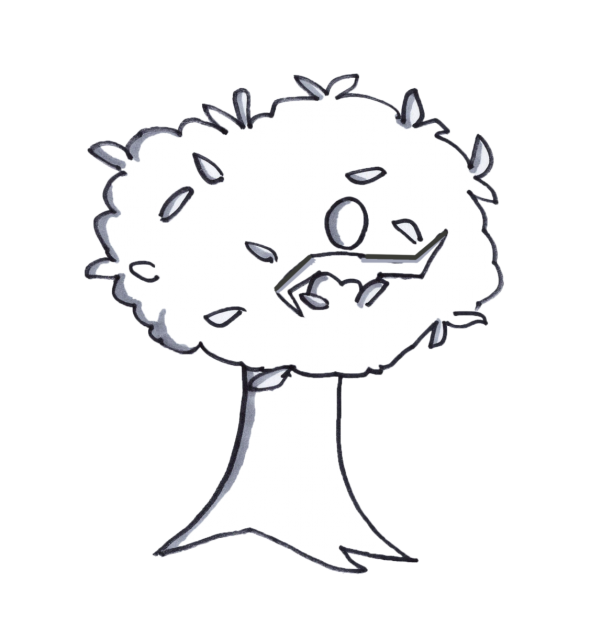 Our job is to recognize who is throwing rocks at our customer (a confusing feature? an inadequate service?) and then figure out how to get them out of the tree safely. This approach helps to get the customer to open up to us so we can toss them something of value that can get us into the conversation.
Finding the themes and patterns across our interviews.
There is a lot out there about the mechanics of user interview questions — how to take notes, how many customers make up a cohort, how many cohorts to conduct before moving on to our build — but all the mechanics in the world won’t help if we don’t know how to analyze data from a pile of interviews, to find the themes and patterns we need to zero in on our target persona and build them something they are willing to lay down cash for. This is where we again borrow from the elements of storytelling. To return to our trip-planning example from Part 1 of this post, we find commonalities — themes and patterns — in the details of our customer stories. Eventually our target persona is boiled down to couples without children who buy discount ski packages during what they call “tequila season.” (I don’t know what product is being sold here, but I already know I want one). 
Feeling awkward and uncomfortable talking to a stranger.
It’s a universal phenomenon — whenever we’re heading into a meeting, a part of us hopes the other person doesn’t show up. But really it’s just the first minute that’s painful. Once we get past that part, then bam, we are in a full-on conversation with another human being. This is one of the reasons we suggest coming up with a simple introduction that the introverted can memorize to get past those awkward first few sentences. Then the key is to focus on the other person rather than the mechanics of the interview. In other words, get the pleasantries out of the way and prompt them to share their stories. Once we get past the initial lack of familiarity and let the customer’s narrative take control of the conversation, our natural empathy will find commonality and community between their obstacles and our product.  That’s what storytelling is: finding ourselves in the characters being related to us. A successful customer discover interview should be a sharing experience. Ultimately we want to find the place where the customer’s conflict intersects with our solution — that is the sweet spot where the customer and the interviewer find themselves complementary characters in the same story.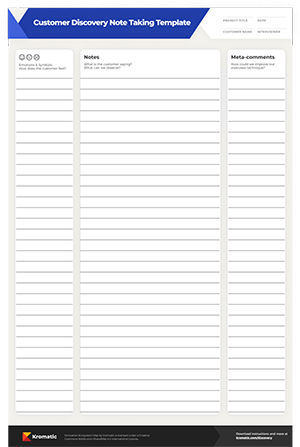
Download our Customer Discovery Notetaking Template
Lessons Learned
Our customers’ needs lie in their stories: the conflict set up by the characters, settings, and plots of their lived experiences. Want more guidance on customer discovery interviews? Curious about other innovation techniques? Kromatic is now enrolling cohorts in our online interactive programs.
Frequently Asked Questions
How do you get customers to open up during user interview questions?
The key is to lead with their problem, not your pitch. Instead of saying “I want to show you something,” ask “Do you have this problem?” People naturally enjoy talking about their struggles. Problems are stories with conflict and resolution built in, and recognizing the conflict in a customer’s life primes them to see you as a potential resolution.
How do you find patterns across multiple customer discovery interviews?
We borrow from storytelling elements by looking for commonalities in the details of customer stories — recurring characters, settings, and conflicts. Rather than just analyzing raw data mechanically, we listen for shared themes across narratives. Eventually these patterns help us zero in on a specific target persona whose needs we can build a product around.
What’s the best way to handle feeling awkward during user interviews?
Prepare a simple, memorizable introduction to get past those painful first few sentences — then shift focus entirely to the other person and their stories. As product managers, we all dread that first minute, but once we prompt customers to share their narrative, our natural empathy kicks in and turns the interaction into a genuine conversation rather than an uncomfortable interrogation.
Why should user interview questions focus on storytelling instead of logistics?
Because our customers’ real needs are embedded in the conflict, characters, and plots of their lived experiences — not in yes/no answers to scripted questions. A storytelling approach helps customers open up, reveals deeper patterns across interviews, and leads us to the sweet spot where a customer’s conflict intersects with our solution.
What makes a customer discovery interview successful?
A successful interview is a sharing experience where the customer’s conflict intersects with our potential solution. We want to find that sweet spot where the customer and interviewer become complementary characters in the same story — their obstacle meets our product. This requires listening to narratives rather than just collecting data points.


Comments
Loading comments…
Leave a comment