
What Is an Innovation Ecosystem? Definition, Elements & Why It Matters
It's not about the list of players — it's about who's eating the hot dogs.
 By Tristan Kromer · · 8 min read
 By Tristan Kromer
 I don’t remember when I first heard the term innovation ecosystem, but I do remember how it had an immediate appeal. It sounded important. Something everyone should be concerned about. Strictly speaking, an innovation ecosystem is a system for repeatedly delivering new, sustainable business models. It is composed of people, but also processes and systems that can support a concept from ideation to a scalable business. But even having used the term for the past four years, I have to admit I had a loose grasp on what it actually was. This point was brought home to me by lean startup guru Brant Cooper, with whom I frequently share the stage. During one presentation, Brant decided right before his talk that “innovation” was a silly word, and crossed it out on every slide. He then declared to the room that we shouldn’t use the word if we couldn’t define it. Since I was the next speaker, I followed his lead and frantically crossed the word out of my presentation too. Neither of us got very far into our talk without saying it, because hey, it’s the buzzword of the day. Regardless, Brant was right. We rarely define the word “innovation” sufficiently, and I have yet to come across an adequate definition of one of our most important terms: Innovation Ecosystem. So let’s break it down one word at a time.
Quick Answer: An innovation ecosystem is a sustainable system for repeatedly delivering new, sustainable business models — built not on a list of elements (universities, accelerators, investors) but on the relationships between them. Understanding this distinction is critical: invention creates a product, but innovation creates a business, and an ecosystem’s value lies in how its elements exchange resources and information. By mapping and manipulating those interactions, we can move beyond simply understanding our innovation ecosystem to actively controlling it for maximum value.
What is innovation?
Innovation is a poorly understood concept, and even the Oxford English Dictionary isn’t much help. The primary definition simply restates the term: The action or process of innovating. The second definition is far too broad: A new method, idea, product, etc. I suspect much of the vagueness surrounding “innovation” exists because we often confuse it with “invention.”
Innovation is about creating value.
The classic example of innovation is the Apple iPod, and Steve Jobs is the classic innovator. But Steve Jobs did not invent the iPod.  Kane Kramer patented the concept of a portable digital music player in 1979, the same year the walkman gave people with cassette tapes the ability to “bring your music everywhere.” Apple wasn’t even the first company to attempt a product from Kramer’s invention. MP3 players from Diamond, Creative Labs, and Sony were already on the market before the iPod came out in 2001. Steve Jobs didn’t even name the iPod. That was done by Vinnie Chieco, who didn’t even work at Apple. So whatever innovation is, it isn’t just invention, or marketing, or creating catchy names. Innovation is about creating value. Kramer invented the digital music player, but failed to create any sustainable value. Brilliant as he was to patent the idea at 23 years old, Kramer couldn’t get enough funding to take his concept to market in a meaningful way. Steve Jobs, however, was very good at bringing different elements together into a unique and novel configuration that was highly valued by the market. His innovation was not the iPod, it was the iPod + Apple Music + musicians + (eventually) the App Store + the means for outside entrepreneurs to make apps. Steve Job’s innovation was Apple. From the original Apple computer, to the Mac, to the iPod, to the iPhone, Apple’s business model continued to change over and over again, and deliver enough value to enough people to keep growing. This definition doesn’t require building on a massive, billion-dollar scale. It just needs enough scale to be sustainable.
Innovation vs. invention
From that example, we can clearly say that innovation is not invention. 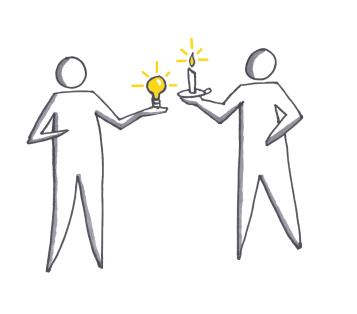 Invention refers to a single product or service. To invent is to create something that has not existed before. An invention is a product or service that is fundamentally new. Innovation is a process. To innovate is to combine business model elements into a novel configuration that delivers more value than the individual elements. It is the process of creating a business that’s new and sustainable at any given scale. If invention is creating a product, innovation is creating a business.
Invention is singular. Innovation is plural.
Invention requires the creation of a prototype or diagram of the product. Innovation requires some degree of scale. It is not about producing one, ten, or a million units. But it does require some repeatable means of producing those inventions and delivering them to customers over and over again.
Action creates inventors. Users create innovation.
The only qualification for being an inventor is to engage in the creative process. It doesn’t matter if the output is good or bad. It only matters if the inventor is not trying to recreate something that already exists. Inventors can give themselves the title by their actions alone. Innovators can only be called innovators if the customers and users agree. If the business model doesn’t create a compelling value proposition that users will buy, then putting “innovator” on a LinkedIn resume is meaningless bluster. 
Inventions are tangible. Innovations are intangible.
Inventions, by definition, produce an output. Even inventing a new service involves some sort of physical act. Innovation is about business models, which are fundamentally composed of knowledge, not physical objects. We can look at a diagram of a business model and see the interactions between customers, products, resources, revenue, and costs. But we cannot look directly at a business model. There is nothing physically there.
Invention is an event. Innovation is a process.
An invention occurs once and then never again. Only the first person gets the prize. But innovation is only considered innovation if it is sustainable to some degree. Someone who creates a business that dies within a year can hardly be considered an innovator. Short-lived business models that do not lead to bigger things are not innovations, they are fads.
What is an ecosystem?
Most people who try to define ecosystem wind up talking about plants and fish and trees, and waving their hands around like they’re explaining something. Oxford does a little better on this one: 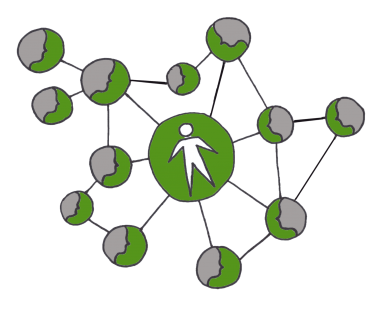 The key takeaway is the idea of interaction. A biological ecosystem is not built on a list of things within the community, it is built on the relationships between those things. An innovation ecosystem is not built on a list of people and places (universities, accelerators, angel investors, fab labs). It is built on the relationships between them, the exchange of information and resources that make a sustainable system. Imagine a map of New York City that just listed a bunch of things:
- A whole lot of people
- Even more rats of various shapes and sizes
- A massive amount of concrete
- Two baseball teams
- An army of hot dog vendors
While technically all of those things are part of New York, such a map wouldn’t help me find Houston street or even a decent hot dog. A functioning map needs to show the relationships between these things. For a street map, showing distance at scale would be a good start. For an ecosystem map, a good starting place might be to know who is eating whom. In this case, the people aren’t (generally) eating the rats, they are eating the hot dogs. The rats are also eating the leftover hot dogs, and in some unspeakably rare cases, wind up being made into hot dogs. The baseball teams aren’t really eating anyone, but they are consuming the money from the people via the purchasing of hot dogs at their games. The concrete is of course what everyone is standing on. No one eats that. What is important is the relationship between the elements, not simply a list of the elements themselves. The elements must be interacting in some meaningful way by exchanging resources, or to put it more simply, exchanging inputs and outputs in a sustainable manner.
What is an innovation ecosystem?
If innovation is the process of creating business models that are new and sustainable at any given scale, and an ecosystem is a community of interacting parts, then an innovation ecosystem is a sustainable way of delivering ongoing innovation via the interaction of its elements. 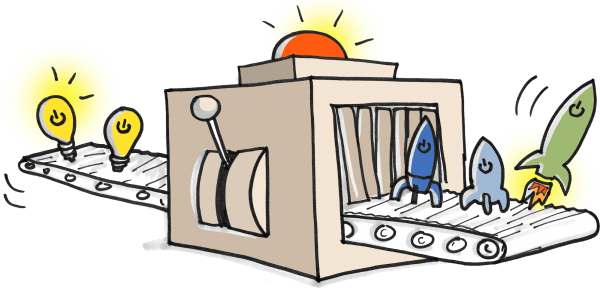 The output of innovation is value. The output of the ecosystem is constant innovation. But defining an ecosystem is just the first step. If our goal is to increase our ability to innovate, then we need to discover the levers we can use to manipulate the input/output relationships within that ecosystem for maximum advantage. If we can do that, we can go beyond simply understanding our innovation ecosystem, and begin to control it.
Lessons Learned
- Invention is creating a product; innovation is creating a business.
- An ecosystem is a sustainable system of interactions between elements.
- An innovation ecosystem is a system for repeatedly delivering new, sustainable business models.
Download the Innovation Ecosystem Booklet
Frequently Asked Questions
What is an innovation ecosystem?
An innovation ecosystem is a sustainable system for repeatedly delivering new, sustainable business models. It’s composed of people, processes, and systems that support a concept from ideation to a scalable business. Crucially, it’s not just a list of elements like universities, accelerators, and investors — it’s built on the relationships and exchanges of resources between those elements.
What’s the difference between innovation and invention?
Invention is creating a single new product or service — it’s a tangible, one-time event. Innovation is the ongoing process of combining business model elements into a novel configuration that delivers sustainable value. As we like to put it: invention is creating a product, innovation is creating a business. Inventors earn that title through action alone, but innovators only earn it when customers agree the value proposition is compelling.
Why is the iPod considered innovation if Steve Jobs didn’t invent it?
Kane Kramer patented the portable digital music player in 1979, and several MP3 players existed before the iPod launched in 2001. Jobs’s innovation wasn’t the device itself — it was combining the iPod with Apple Music, musicians, the App Store, and a platform for outside developers into a novel configuration that delivered massive, sustainable value to the market.
Why do relationships matter more than elements in an innovation ecosystem?
Just listing the elements of an ecosystem — people, accelerators, fab labs, investors — is like listing “a lot of people” and “hot dog vendors” on a map of New York City. It tells us nothing useful. What matters is how those elements interact: exchanging information, resources, inputs, and outputs in a sustainable manner. By understanding and manipulating those relationships, we can maximize the ecosystem’s ability to produce innovation.
Can small-scale efforts count as innovation?
Yes. Innovation doesn’t require building at a massive, billion-dollar scale. It simply requires creating a business model that delivers enough value to enough people to be sustainable at whatever scale it operates. The key criterion is sustainability — a short-lived business model that doesn’t lead to bigger things isn’t innovation, it’s a fad.

Comments
Loading comments…
Leave a comment