
Lean Startup Hypothesis vs. Assumption: Why the Difference Matters
Stop using them interchangeably — your next decision depends on it.
 By Tristan Kromer · · 5 min read
 By Tristan Kromer Something has been irritating us: The startup community uses the words assumption and hypothesis interchangeably. We also rarely use hypothesis correctly, often referring to laughably vague statements as hypotheses such as this gem we overheard:
Our hypothesis is that a $50k seed round will be enough to show traction.
 We do the same damn thing, hence the irritation. So we should stop doing that, because it has an OVERSIZED effect on our next decision for our startup. tl;dr: Bonus: We’re writing a more complete version of how to design great experiments as an open source “Real Book”, you can get on the download list here:
Quick Answer: A lean startup hypothesis is not the same as an assumption — and confusing the two has an oversized effect on our next decision. Assumptions are vague beliefs we take on faith and accept the risk of being wrong. Hypotheses are specific, measurable, and falsifiable statements we actively test with experiments. As product managers, we should convert our riskiest assumptions into concrete IF/THEN hypotheses with real numbers and timeframes, then design experiments to disprove them.
The Dictionary
 While they are listed as synonyms by many dictionaries, they are really not the same word. Here’s a definition for Assumption from Merriam-Webster (because we’re too damn cheap to pay for the OED):
a fact or statement (as a proposition, axiom, postulate, or notion) taken for granted - Merriam-Webster
Here’s hypothesis:
an assumption or concession made for the sake of argument - Merriam-Webster
Oops…that’s almost identical and even used the word assumption, but not quite. It’s an assumption…for a specific purpose. Here’s a clearer definition.
a tentative assumption made in order to draw out and test its logical or empirical consequences - Merriam-Webster
Now that’s an interesting difference, and it’s important because depending on whether we have an assumption or a hypothesis, we should do two different things. If we have an assumption, we accept the risk that the assumption is false and move on. If we have a hypothesis, we attempt to falsify it.
Research Assumptions
If we look up a few more of assumption’s numerous definitions we’ll also get a sprinkling of the religious roots of the word. That’s appropriate because the heart of the word is that we take it on faith. For our startup, an assumption is usually something that we are not going to investigate. It’s something we will take on faith. We have many assumptions and they’re not all bad. We might look at an analog to a startup idea (a probiotic search engine) and see that the companies that sell probiotics have a lot of internet traffic and it’s growing month over month. We could then assume there is sufficient market size to justify our interest. That assumption may be disastrously wrong. Perhaps those companies are buying traffic with no profit to show for it, but we are free to make that assumption and take the risk. Hint: By “testable” we mean falsifiable.
Convert Assumptions into Hypotheses
Assumption
Hypothesis
The market is large enough to support this business.
There are 20,000 search queries per month using the term ‘probiotic’ and this number will grow by 20% next month.
Our product solves the problem.
If a visitor shopping for probiotics comes to our landing page, they will enter a search query.
We’ll be able to raise an angel round really easily.
If we send a cold email to 10 angel investors on Angel.co we’ll be able to get 3 meetings within two weeks.
As you can see, all the assumptions are vague, optimistic, and untestable. The vaguer they are, the harder they are to disprove. What makes a good hypothesis? The hypotheses above are relatively specific and we can easily see how to design an experiment to get the data that could disprove that hypothesis.
Hidden Assumptions
The most dangerous kind of assumption is the one we don’t know we have. In Rumsfeldian, that’s an “Unknown unknown.” 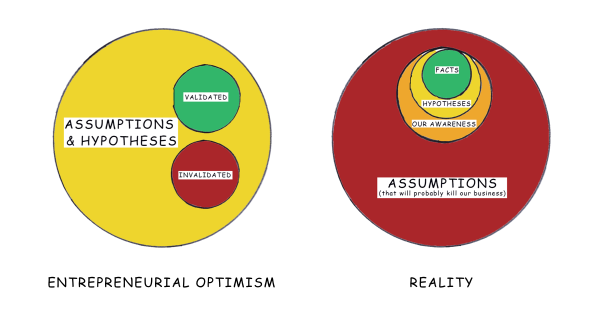 To reveal hidden assumptions, there are a few tried and true generative research methods:
- Use a framework such as the Business Model Canvas to list your assumptions
- Have a peer challenge you with questions about your business model
- Watch your customers try to solve their own problems
- Talk to your customers!
Ready to Test? What is a good hypothesis?
Before we get excited and start building anything and before we start talking about our hypothesis, let’s make sure it’s a real, falsifiable hypothesis and not just a vague assumption. Look at the hypothesis and go through this checklist:
Symptom
Fix
Are there vague words like “some people” or “customer”?
Be specific. Create a well defined customer persona.
Is it falsifiable? What evidence would convince a reasonable person that the hypothesis is wrong?
Create a measurable hypothesis. Eliminate hedging words like “maybe,” “better,” “some” and convert to and IF ________ THEN ________ statement.
Is it actually risky?
If it’s not truly risky, it’s not relevant and we don’t need to test it right now. (It may get more risky later and resurface.)
Has a second set of eyes looked at it?
We all have blind spots. Check your work with another entrepreneur and ask them to tighten up the hypothesis.
What have we missed on this checklist? Got a tip? Tweet me. Bonus: We’re writing a more complete version of how to design great experiments as an open source “Real Book”, you can get on the download list here:
Frequently Asked Questions
What’s the difference between an assumption and a hypothesis in lean startup?
An assumption is something we take on faith and accept the risk that it might be wrong. A lean startup hypothesis is a specific, testable version of that assumption — designed so we can actually run an experiment to disprove it. If we have an assumption, we accept the risk and move on. If we have a hypothesis, we attempt to falsify it.
How do you write a good lean startup hypothesis?
A good lean startup hypothesis is specific, measurable, and falsifiable. We should convert vague assumptions into IF/THEN statements with concrete numbers and timeframes. For example, instead of “the market is large enough,” write “there are 20,000 search queries per month for ‘probiotic’ and this number will grow by 20% next month.” Eliminate hedging words like “maybe” or “some.”
How do you find hidden assumptions in your business model?
Hidden assumptions — the ones we don’t even know we have — are the most dangerous. We can reveal them by using frameworks like the Business Model Canvas to list assumptions explicitly, having a peer challenge us with questions about our model, watching customers try to solve their own problems, and simply talking to customers directly.
What makes a hypothesis falsifiable vs. just a vague assumption?
A vague assumption uses hedging language like “some people,” “better,” or “enough” — making it nearly impossible to disprove. A falsifiable hypothesis specifies exactly who, what, and how much, so we can clearly define what evidence would prove it wrong. If we can’t describe what failure looks like, we’re still dealing with an assumption, not a real hypothesis.
Should you test every assumption in your startup?
No. As product managers, we should focus on assumptions that are truly risky — ones that could sink the business if they’re wrong. If an assumption isn’t genuinely risky right now, it’s not relevant to test yet. We should prioritize converting our riskiest assumptions into hypotheses and testing those first. Less risky ones may resurface later.
Comments
Loading comments…
Leave a comment