

The 4 Types of B2B Persona: A Simple Framework for Leads
Fire Freddie, Smokey Sam, and friends who'll save your pipeline
 By Kenny ·
 (B2B Persona- This is a guest post by Kenny Nguyen, who has spent the last six years helping B2B companies with marketing and sales. He describes himself as a guy who “doesn’t like sales, but you have to sell if you’re going to help people.” You can find Kenny on Twitter.)  It’s hard to keep tab of sales when we’re talking to one potential customer after another. B2B startups founders - with limited sales experience, myself included - have trouble with qualifying leads. As a consequence, focus ends up being diluted across way too many leads at the same time. B2B founders could benefit from having a fast and effective qualification process then talking to B2B persona/customers. There are great tools out there to help manage pipelines, ask questions, flowcharts, and analyze potential sales top-down, but there isn’t much available to help qualify potential customers in a no-nonsense manner. To cut to the chase, you can download the cheat sheet here: Download
Too Much Jam in the PBJ
 Many B2Bs qualify potential customers by jotting down simple notes during sales meetings. Those that are more disciplined will have a cheat sheet of questions to ask and scripts that outline salient topics. When meetings are finished, people look at their sales pipeline on the computer screen and arbitrarily shove new leads (be it truly qualified or not) somewhere in the pipeline and go from there. And after shoving so many different leads into the pipeline, B2Bs begin losing track on what is truly qualified, what is still in discovery mode, what is unqualified, and what should move back into the marketing funnel.
Quick Answer: As B2B startup founders, we can qualify leads faster by mapping prospects on a simple 2x2 matrix based on two variables: whether they understand they have a problem and how urgently they need a solution. This creates four B2B persona types — from “Fire Freddie” (aware and urgent, our top priority) to “Confused Craig” (unaware and indifferent, push back to marketing). Paired with a checklist covering budget, pain, benefits, evangelist support, and technical objections, this framework prevents us from diluting focus across unqualified leads.
2x2 Equals Sanity
We need to focus on the two most important variables:
- Does the potential customer understand they have a problem?
- How urgently is the customer looking for a solution?
Our 2x2 for qualifying potential customers should look something like this: 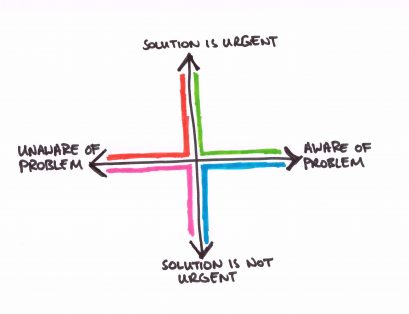 We can categorize potential customers/ B2B persona by laying them out on this matrix using a wall with tape and sticky notes, or on a piece of paper. This allows us to quickly map, checklist, and classify when talking to potential customers. If mapped effectively, we can read into the prospect’s priority level and whether or not the prospect is going to buy something now, or much (much) later. Let’s imagine four different personas reacting to a building on fire: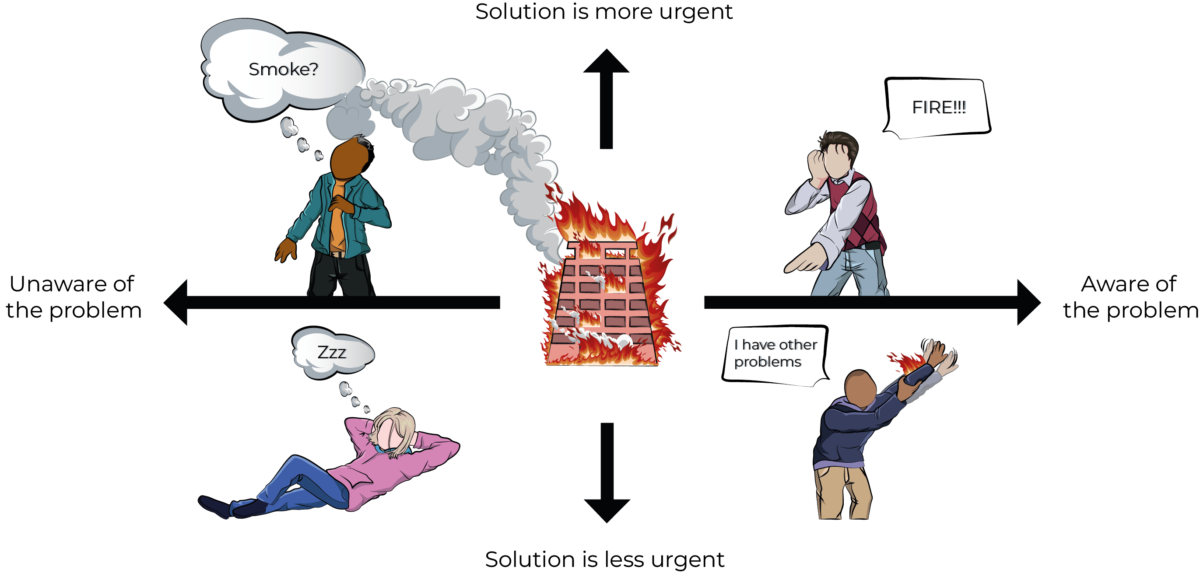
- Fire Freddie: Knows that the building is on fire and is urgently looking for a solution.
- Smokey Sam: Notices there is a problem, but is not sure where the smoke is coming from.
- Issues Eli: Also knows that the building is on fire, but has more urgent problems to solve.
- Confused Craig: Has no clue what is going on and/or doesn’t care.
The Master Checklist
Every startup needs a checklist to qualify leads as real opportunities. The checklist will be different for startup to startup and we need to figure out the ideal qualifying criteria for our product, industry, and customers. But we need to startup with something, so here’s a starting point similar to what you’d find in most B2B sales play books. Here are examples:
- Budget: Is there a budget earmarked for a solution? Are you in contact with the economic buyer?
- Pain: Can the evangelist or economic buyer quantify costs and pains of not having “your” solution
- Benefits: Do they think your solution will help them get more customers?
- Evangelist: Do the evangelist’s colleagues also see the problem? Or is the evangelist alone?
- Technical Buyer: Are there hidden costs of objections to buy or implement your solution?
What’s Next?
So far we have laid out a way to map and qualify potential customers. We also have a checklist that will give guidance on where and how to map potential customers. You can find a downloadable cheat sheet below for reference. This tool will help quickly figure out which leads are qualified leads to focus on. Download
Frequently Asked Questions
What are the 4 types of B2B persona in sales qualification?
The four B2B persona types are based on problem awareness and urgency: Fire Freddie (aware and urgent), Smokey Sam (somewhat aware but not urgent), Issues Eli (aware but busy with other priorities), and Confused Craig (unaware or indifferent). Mapping prospects into these categories helps us prioritize which leads deserve our immediate attention.
How do I qualify B2B leads without a complex sales process?
We can use a simple 2x2 matrix based on two variables: whether the potential customer understands they have a problem, and how urgently they’re looking for a solution. By plotting prospects on this matrix during or after conversations, we can quickly classify leads and avoid the common trap of shoving unqualified leads into the pipeline alongside real opportunities.
What criteria should B2B startups use to qualify sales leads?
A solid starting checklist covers five areas: Budget (is money earmarked and are you talking to the economic buyer?), Pain (can they quantify the cost of not having your solution?), Benefits (do they believe your solution helps?), Evangelist (do their colleagues also see the problem?), and Technical Buyer (are there hidden objections to buying or implementing?). Every startup should adapt these criteria to their specific product and industry.
Why do B2B startup founders struggle with too many leads in their pipeline?
As founders with limited sales experience, we tend to arbitrarily shove new leads into the pipeline after meetings without properly qualifying them. Over time, we lose track of which prospects are truly qualified, which are still in discovery, and which should move back into marketing. This dilutes our focus across too many leads and slows down actual sales progress.
How does the B2B persona framework help prioritize sales efforts?
By categorizing prospects into the four B2B persona types, we can immediately see who needs attention now versus later. A “Fire Freddie” who knows they have a problem and urgently needs a solution should get our focus first, while a “Confused Craig” who doesn’t even recognize the problem likely belongs back in the marketing funnel rather than consuming valuable sales time.


Comments
Loading comments…
Leave a comment