
Lean Product Development: Why Product Managers Must Think Beyond Agile
You're not a story-writing machine. Act like it.
 By Tristan Kromer·· 4 min read
Quick Answer: As product managers, we’ve let ourselves be squeezed into narrow product owner roles focused on sprint mechanics while ignoring our biggest risks: markets, viable solutions, and cross-organizational alignment. The future of lean product development demands a mixed-team-of-experts model — pairing a strategic product manager with financial and go-to-market chops, a UX lead skilled in generative research, and a technologist who understands solution architecture. We need to reclaim strategic responsibilities like validation, pricing, and competitive analysis, not just write user stories.
(This is a guest post by Rich Mironov, who coaches product executive and lean product development/owner teams. He wrote The Art of Product Management. You can find Rich on Twitter, LinkedIn or on his blog.) I was at a recent Lean Startup Circle talk about the future of product management. It was a “back to the future” moment for me, hearing about the need for the strong strategic product management that predates Lean and Agile. A return to first principles, but with more build-measure-learn. Some history: for its first three or four decades, technology lean product development had an engineer-meets-MBA profile. Product cycles were long and computing was mostly for businesses, so deep upfront analysis was critical. Every product plan started with market sizing data, competitive analysis and speculation about next-gen technology. Before we spent $50M building something that our customers would pay $100k each for, we really needed to prove out the economics. Portfolio analysis, adoption cycles and business models ruled. Design expectations were low and UI was about screen-level layout. UX was a mostly foreign concept. The inevitable failure modes were products that were late, didn’t address serious needs or were badly designed. And product managers had an inflated sense of our importance. Great products need a mix of
- economic market insights,
- working technical architecture,
- user-centered design, and
- organizational leadership to keep the rest of the company aligned.
Classic waterfall product management delivers 1 and 4 with sprinklings of 2. In my first product roles at Tandem and Sybase, I was stuck between architect-led development plans (“here’s what our smart customers will need next year”) and enterprise-sales-driven interrupts (“we can close a $10M deal if we can commit to teleportation in our next release.”) For me, validation was a dozen personal interviews with forward-thinking customers. We’re a decade into Agile, which has tilted this model toward Engineering. In practice, agile product owners focus almost entirely on the mechanics of getting products defined and shipped, with almost no cycles left for higher-level business goals, broad customer validation or the organizational challenges of marketing/sales/support. Terrific books from Roman Pichler and Greg Cohen teach us how to perform the inward-facing functions of agile product owners — but assume that someone else owns product strategy, portfolio planning, segmentation, pricing, competition, customer commitments and turning technology into money. Product owners typically write individual user stories and accept work, but don’t drive strategic whole product decisions. Product owners also look to some all-powerful executive sponsor who fights off daily attempts to steal resources or shift goals. 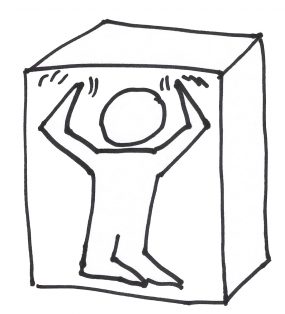 We’ve been focused on inward process efficiency when the biggest risks are about markets, viable solutions, and organizing complex sets of employees/partners/suppliers. User experience professionals and designers were mostly left out of command-and-control product management and early agile. Design was a nice-to-have, a late-stage addition alongside documentation. Button placement, not needs analysis. I’m a cheerleader for Lean UX, which brings problem validation and deep customer understanding to the fore: ethnography, value propositions and mapping the user’s journey – then quick-turn prototyping and a wide range of real user testing. I’m also a cheerleader for Lean UX’s mixed-team-of-experts model. A UX lead who brings experience with generative research and behavioral models; a seasoned product manager with financial and go-to-market chops; a technologist who understands workable solution architectures. The future demands strong product management as well as deep design expertise as well as brilliant technology. Let’s get collaborating.
Frequently Asked Questions
What is lean product development and why does it matter for product managers?
Lean product development combines economic market insights, working technical architecture, user-centered design, and organizational leadership to build products that actually succeed. As product managers, we need to move beyond the narrow product owner box and reclaim strategic responsibilities like market validation, pricing, competitive analysis, and turning technology into money — not just writing user stories and accepting sprint work.
How has Agile reduced the strategic role of product managers?
Agile has tilted the product management model heavily toward engineering mechanics. In practice, product owners focus almost entirely on defining and shipping products — writing individual user stories and accepting work — with almost no time left for higher-level business goals, broad customer validation, segmentation, pricing, or the organizational challenges of aligning marketing, sales, and support. We’ve essentially traded strategic influence for process efficiency.
What does Lean UX bring to product development that was missing before?
Lean UX brings problem validation and deep customer understanding to the forefront through ethnography, value proposition work, and mapping the user’s journey, followed by quick-turn prototyping and real user testing. Design was historically treated as a late-stage, nice-to-have addition — button placement rather than needs analysis. Lean UX elevates design to a strategic discipline alongside product management and engineering.
Why is the mixed-team-of-experts model important for lean product development?
The mixed-team-of-experts model pairs a UX lead with generative research and behavioral model experience, a seasoned product manager with financial and go-to-market skills, and a technologist who understands workable solution architectures. This collaboration matters because great products demand strong product management, deep design expertise, and brilliant technology working together — no single discipline can cover all the risks alone.
What are the biggest risks in product development that teams overlook?
As product managers, we’ve been focused on inward process efficiency when the biggest risks are actually about markets, viable solutions, and organizing complex sets of employees, partners, and suppliers. Before Agile, the failure modes were products that were late, didn’t address serious needs, or were badly designed. Those risks haven’t changed — we’ve just shifted our attention away from them.

Comments
Loading comments…
Leave a comment